

Focal Electra 1008 Be2: sound character, system matching, and used-market context
The Electra 1008 Be2 is a high-resolution stand-mount that behaves less like a bright beryllium showcase and more like a disciplined monitor. On the used market, its original engineering ambition is available at a fraction of the launch price.
Focal Electra 1008 Be2 — sound character, system matching and used-market context
Intro / Lead
The Focal Electra 1008 Be2 launched at roughly $4995-$5499 per pair, a price that made it an unusually ambitious stand-mount even by premium hi-fi standards, and today it survives mostly as a used-market proposition for buyers who still care about compact high-end loudspeakers that do not sound apologetic about their size. That alone makes it worth revisiting. The high-end monitor market has become far less shocking than it was in 2010-2011, but the basic question remains the same: if you are going to pay serious money for a bookshelf speaker, what exactly are you buying beyond luxury finish, boutique branding, and a promise of detail?
In the case of the Electra 1008 Be2, the answer starts with engineering. This is a two-way monitor from the Electra 1000 Be II family, built around Focal's 27 mm pure-beryllium inverted-dome tweeter in IAL loading and a 165 mm W-cone midbass driver, wrapped in a cabinet that is far more elaborate than the average box of this size. But the speaker's enduring reputation does not come from the word beryllium alone. Across English (SoundStage! Hi-Fi, The Audio Beat, NOVO), German (connect.de / stereoplay), and Polish review coverage (Audio.com.pl, Hi-Fi i Muzyka), the more interesting pattern is how often the 1008 Be2 is described not as a flashy treble machine, but as an unusually coherent, highly resolved, surprisingly authoritative mini-monitor that rewards careful system matching.
That last point matters, because the speaker sits in an awkward but fascinating place in the used market. At launch it had to defend itself against larger floorstanders, cheaper internal alternatives, and the temptation to jump all the way up to something like a Diablo Utopia if money was no object. In 2026 the conversation changes. The original sticker shock is gone, used-market traces on HifiShark show a materially more attractive second-hand bracket, and what remains is the actual product: a compact reference speaker with serious strengths, real conditions attached, and enough surviving evidence to judge it on more than nostalgia.
This analysis is a synthesis of public reviews, measurements, manuals, pricing data, and owner discussions. It is not a first-hand audition report. The goal is to establish, as honestly as the evidence allows, what the Electra 1008 Be2 is, where it still excels, where it asks for cooperation from the rest of the system, and why it can still make sense for the right buyer.
DNA Of The Device
The first constitutive trait of the Electra 1008 Be2 is precision. Not sterile precision, not microscope-for-its-own-sake precision, but a clear tendency toward sharply resolved leading edges, explicit image outlines, and a level of insight that keeps upstream electronics from hiding behind vague adjectives. This is not a speaker that smears over differences in DAC voicing, amplifier quality, or recording competence.
The second trait is authority beyond apparent size. Nearly every strong source comes back to the same surprise: for a stand-mount, the 1008 Be2 sounds physically larger, more confident, and more dynamically secure than expected. That does not mean it reaches true floorstanding bass depth, because it does not, but it does mean the cabinet behaves like a serious instrument rather than a miniaturized compromise.
The third trait is disciplined system sensitivity. Electrically, the speaker is not a horror story. Independent NRC measurements and multiple reviews all suggest it is more amplifier-friendly than the mythology around beryllium Focals would imply. Yet it remains demanding in a more important way: it reveals the tonal and qualitative decisions made earlier in the chain. Feed it a smooth, capable, well-balanced system and it sounds articulate and complete. Feed it something coarse, undernourished, or overly bright and the speaker will not cover for those decisions.
Quick Decision Profile
Three strongest arguments
- Exceptional resolution, speed, and image stability for a compact loudspeaker.
- More punch, scale, and bass authority than most stand-mounts of similar size.
- Premium build and genuine used-market relevance rather than collector-only curiosity.
Three conditions or cautions
- It is not the right choice if you want a lush, forgiving, warmth-first presentation.
- Bass quality is high, but ultimate low-end extension still belongs to bigger speakers or sub-supported systems.
- It deserves quality amplification and sensible placement even if it does not need huge wattage.
Who it fits
Best for the buyer who wants a serious reference-style monitor for a small or medium room, values resolution and control, and is willing to think about system balance.
Who it probably does not fit
Less convincing for plug-and-play buyers chasing maximum bass depth, overt warmth, or a speaker that flatters every recording and every amplifier equally.
Build And Technical Specification
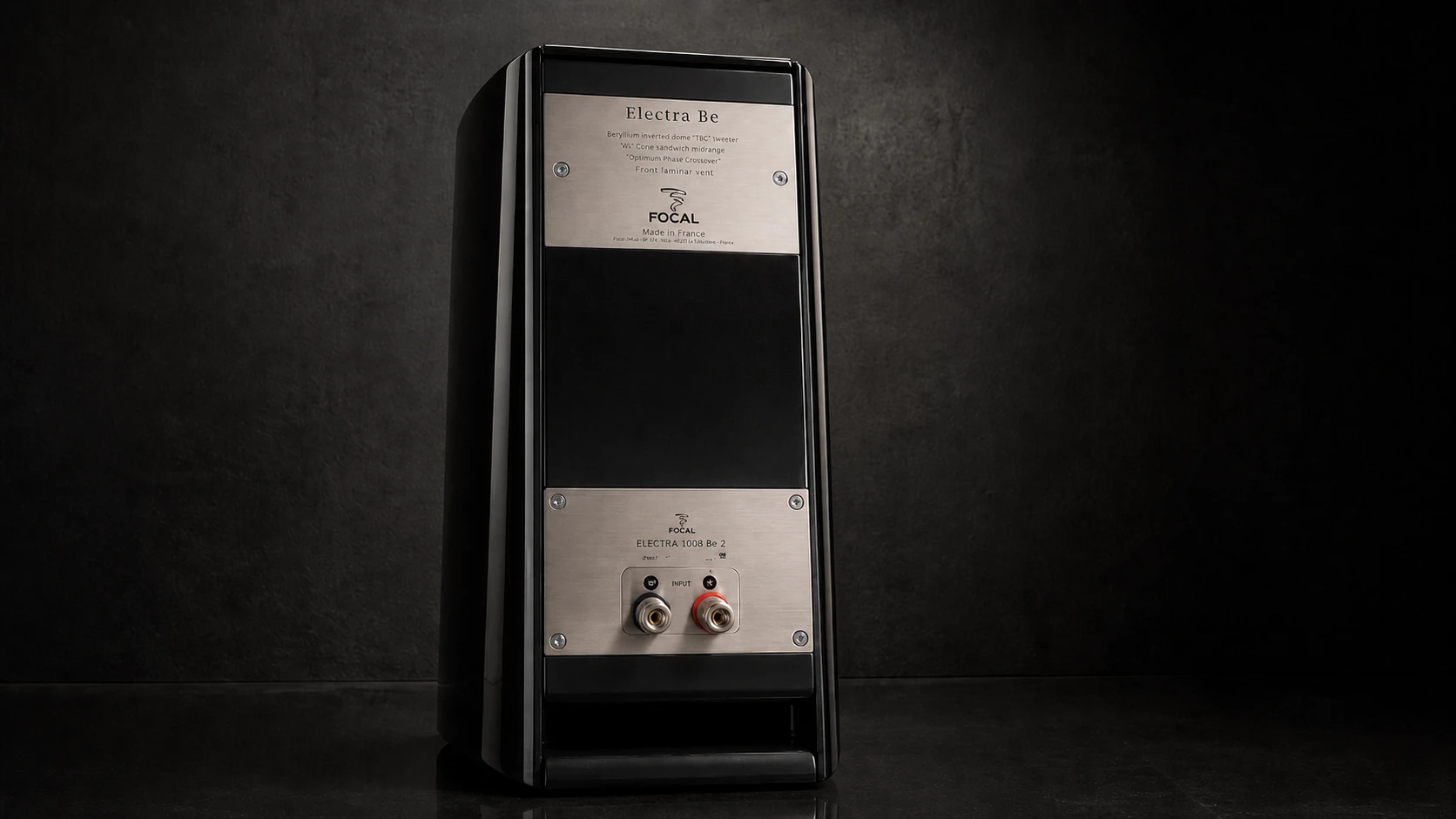
If you looked only at the raw category label, the Electra 1008 Be2 might appear to be just another expensive two-way stand-mount. The cabinet and driver package make it clear that Focal intended something more ambitious than that. Multiple sources, including The Audio Beat, NOVO, Audio.com.pl, and Hi-Fi i Muzyka, converge on the same general picture: the 1008 Be2 borrows heavily from the engineering language Focal used to establish the Utopia and upper Electra families, then compresses that thinking into a monitor that still behaves like a serious hi-fi object rather than a lifestyle bookshelf speaker with luxury cosmetics.
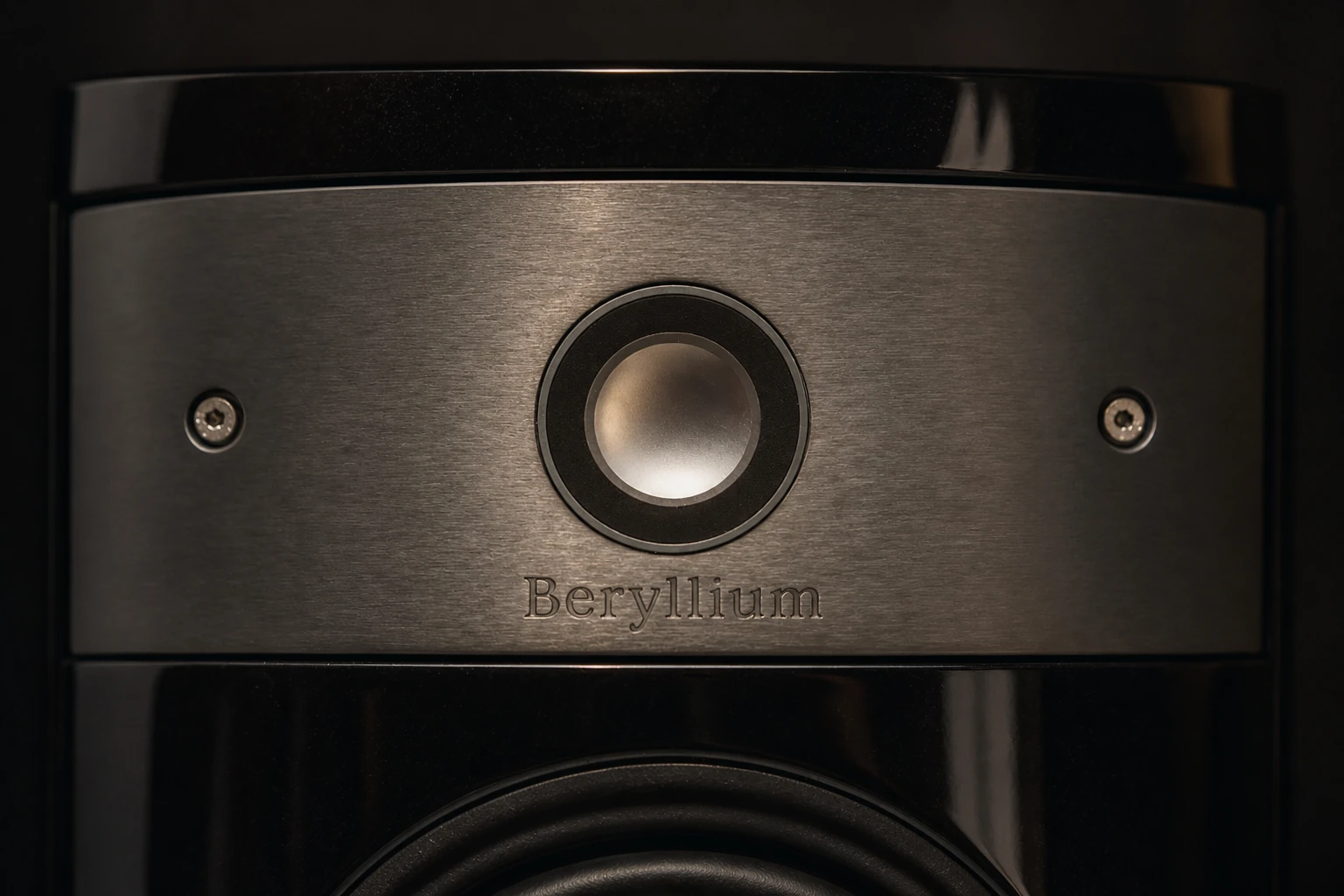
The headline component is of course the tweeter. Focal's pure-beryllium inverted dome had already become a signature technology by the time the 1008 Be2 arrived, but the relevant point here is not only that it exists. According to The Audio Beat and the Polish technical reviews, the implementation matters just as much: the dome grew from 25 mm to 27 mm, the rear loading was opened up through Focal's IAL approach, and the crossover could therefore be brought down to 2200 Hz. That is important because it pushes more of the critical upper-mid / lower-treble region toward a driver engineered for speed, low breakup behavior, and wide extension. It is also one reason the speaker's presence, articulation, and transient definition are so central to how reviewers describe it.
Below that sits the 165 mm W-cone midbass driver. Focal's W material is the company's long-running glass-foam-glass composite approach, tuned in thickness and layering depending on the job it has to do. The result, in design terms, is a driver intended to combine stiffness, low mass, and damping without leaning on simple paper-cone warmth or polypropylene softness. That helps explain one of the repeating tonal signatures of the 1008 Be2: its low end is described far more often in terms of contour, motor drive, and structure than in terms of plush bloom.
The cabinet is more elaborate than many competitors at the size. The front baffle is curved and heavily built, the side panels taper toward the rear to reduce standing-wave behavior, and several sources underline the unusually luxurious finishing. Audio.com.pl and Hi-Fi i Muzyka both stress that the enclosure is not merely decorative high-gloss furniture; its shape, panel thickness and internal treatment are part of the acoustic package. The rear port is a narrow slot rather than a conventional round opening, and the speaker was supplied with foam plugs so the bass output could be moderated when room placement demanded it.
In practical terms, the key specifications are these:
| Parameter | Focal Electra 1008 Be2 |
|---|---|
| Design | 2-way bass reflex stand-mount |
| Tweeter | 27 mm pure beryllium inverted dome, IAL |
| Midbass driver | 165 mm W-cone |
| Crossover | 2200 Hz |
| Frequency response | 46 Hz - 40 kHz |
| Sensitivity | 89 dB claimed / 86.5 dB independently measured |
| Nominal impedance | 8 ohms claimed, mostly above 4 ohms in measurement practice |
| Recommended power | 25-150 W |
| Dimensions | about 385 x 264 x 350 mm |
| Weight | about 15 kg each / 33 lb each |
Two numbers deserve immediate interpretation. The first is sensitivity. Focal's own 89 dB claim sounds comfortably easygoing, while SoundStage's NRC measurement of 86.5 dB is lower but still perfectly respectable for a high-performance stand-mount. Combined with impedance behavior that largely stays above 4 ohms, the message is consistent across SoundStage, connect.de, The Audio Beat, and Audio.com.pl: this is not a punishing electrical load. It is not one of those compact speakers that demands heroic current delivery merely to wake up.
The second important number is the bottom-end claim of 46 Hz. Here the reviews are even more useful than the spec sheet. None of the credible sources pretends the 1008 Be2 turns into a full-range giant killer. Instead they describe a bass register that is powerful for its size, quick, taut, and physically persuasive up to the point where cabinet volume becomes the unavoidable limit. That is exactly how a good stand-mount should be judged. The meaningful practical question is not whether it can replace a large floorstander in the bottom octave, but whether it gives you enough low-end structure and energy that you do not feel cheated in normal music listening. Most of the evidence says yes.
Placement guidance also emerges with useful consistency. connect.de suggests at least 20 cm from the rear wall and notes the supplied port-damping option if bass becomes too strong. The Audio Beat preferred significantly more breathing room, with at least about one meter from the front wall if possible and real space to the sides. The manual mirror at Manua.ls adds the familiar equilateral-triangle guidance and again mentions the foam bung for close-to-wall use. Put together, the speaker looks neither impossibly fussy nor unusually tolerant. It wants some air, and it will tell you when the room is getting in the way.
As an object, then, the 1008 Be2 makes a strong first case for itself. The cabinet, drivers, and measured behavior all support the same conclusion: this is a compact loudspeaker built with reference-level intent. Whether that engineering produces a sound worth the effort depends on the listening evidence, but the technical foundation is not cosmetic.
What Reviewers Say
The broadest agreement across the professional review corpus is that the Electra 1008 Be2 is a highly resolved, highly controlled loudspeaker that sounds bigger and more complete than a monitor of its size has any right to sound. That agreement matters because it emerges across multiple countries, magazines, and review styles: English-language long-form sites, German hi-fi press, and two Polish magazines with very different voices all arrive at roughly the same core picture.
SoundStage gives the cleanest starting point. Philip Beaudette's review repeatedly comes back to three linked impressions: precision, fullness, and cleanliness. Those words matter because they resist the lazy stereotype that a beryllium-tweeter speaker must be defined primarily by brilliance or aggression. What impressed him was not only the leading-edge clarity of cymbals or upper-register information, but the way the speaker sorted a soundstage, held it together, and combined image specificity with genuine body. He heard a stand-mount that could throw an immense stage, stay coherent under dynamic pressure, and sound physically larger than it looked, even if the bottom octave still remained beyond reach. SoundStage later returned to the model with a Recommended Reference Component note, which restated the measurement strengths and reinforced the authority-for-size argument.
NOVO broadly supports that reading, but with a slightly more overtly enthusiastic tone about realism and scale. In its listening tests the 1008 Be II produced a large, well-defined soundstage, strong orchestral scale at higher levels, and bass performance described as respectable, well executed, rich, and musical for the size. Just as important, NOVO did not hear a hard or edgy top end. Quite the opposite: the publication describes the highs as crisp, realistic, rich, smooth and superbly defined. That does not cancel out the speaker's revealing nature, but it does matter for interpretation. A revealing tweeter is not automatically a bright tweeter.
The Audio Beat is the most useful corrective for anyone tempted to over-romanticize the speaker. Chris Thomas clearly admires what the 1008 Be can do, especially in attack, extension, air, dynamic nuance and transient articulation, but he is also the source most insistent that the speaker throws a magnifying glass over the system. In his account, the 1008 Be is not for those who want a smooth, polite, innately relaxed balance. The tweeter can run a little hot in stand-mount Focals, and system balance matters enormously. That caution is not a contradiction of the other positive reviews. It is the missing condition attached to them. The speaker can sound thrilling, textural and sophisticated, but it will not make poor partnering disappear.
The German stereoplay / connect.de review adds another layer. Its listening summary emphasizes effortless handling of complex high-frequency structures, strong punch without boom, and a presentation that compared favorably with the KEF Reference 201/2 by sounding a little rounder and more relaxed while still preserving very fine detail. That is a revealing comparison. The Focal is not portrayed as the more aggressive or more nervous alternative. Instead it is the speaker that keeps resolution high while sounding a touch more fluid and warm-hearted than the KEF. For readers nervous about exaggerated beryllium glare, that distinction matters.
The Polish review in Audio.com.pl is especially valuable because it does not settle for the easy path either. Andrzej Kisiel describes the treble as refined, detailed and explicitly not sharpened. He notes a faint trace of metallic flavor, but in a beneficial, textural way rather than as ringing, glassiness or dryness. His broader tonal summary is one of disciplined neutrality: quick, dynamic, and clear, but without obvious brightening; a clean and stable midrange that leans cool-objective rather than emotionally inflated; and bass that is dense, compact, motoric and solidly grounded without pretending to seismic depth. In other words, the Electra 1008 Be does not seduce through warmth or spotlighting. It seduces through control.
Hi-Fi i Muzyka largely agrees, although it comes from a slightly more music-lover angle. Its author hears treble detail, air and naturalness approaching much costlier studio or electrostatic references, but importantly without the mercilessness that often makes highly explicit speakers tiring with weaker recordings. The same review describes bass as contour-driven, fast, controlled and rhythmically persuasive, especially with Naim electronics, while placing the midrange on the cooler side of neutrality rather than the romantic side. That again supports the central synthesis: the 1008 Be2 is not lush, not thick, and not falsely sweet, but neither is it a crude detail weapon.
The measurement sources strengthen rather than weaken these listening impressions. SoundStage's NRC work reports relatively flat on-axis behavior, controlled dispersion, low distortion even at elevated output, and impedance mostly above 4 ohms. Audio.com.pl's lab section likewise points to strong directional behavior and a tuning choice that avoids aggressiveness around the 2-3 kHz region. Together they suggest that the speaker's poise is not accidental. The 1008 Be2 was voiced and engineered to stay articulate without becoming overtly pushy in exactly the range where many supposedly detailed speakers become tiresome.
So where do the sources genuinely diverge? Mostly in emphasis. The Audio Beat is the most explicit about the need for careful partnering. SoundStage is the most impressed by coherence and authority. NOVO is perhaps the most generous about treble smoothness. Audio.com.pl is the clearest on the speaker's cool, objective center of gravity. Hi-Fi i Muzyka is the strongest on the "detail without cruelty" idea. These are not incompatible stories. They describe different entry points into the same product.
The most defensible synthesis is therefore this: the Electra 1008 Be2 is a reference-minded stand-mount with very high resolution, impressive dynamic grip, large and stable imaging, and more bass mass than expected for the size. Tonally it sits nearer disciplined neutrality than either warmth or analytical glare. Its tweeter is a strength, but the speaker's real achievement is not that the tweeter exists; it is that the whole loudspeaker usually behaves like a coherent instrument rather than a collection of expensive talking points.
Community Voice
The community layer around the Electra 1008 Be / Be2 is not vast enough to support sweeping sociological conclusions, but it is strong enough to sharpen the practical message of the professional reviews. More importantly, the three usable community sources do not push in wildly different directions. They reinforce the same themes: the speaker is desirable, revealing, worth serious partnering, and more about quality than brute-force specifications.
The most useful owner discussion is the StereoNET thread, because it gets past vague admiration and moves straight into the question that matters most for this model: what kind of amplification does it actually want? The best answers in that thread argue that the 1008 does not need a ridiculous amount of wattage, but it does need good wattage. One experienced participant describes the tweeter as revealing and in need of smooth sources. Another points out that the speaker's impedance behavior is actually quite gentle in the upper registers and rejects the claim that it somehow demands large power merely to make the beryllium dome work. A third owner gives concrete matching examples, reporting strong results with a NAD M3 and later a much older Musical Fidelity integrated whose real quality mattered more than the headline number on a brochure.
That is a valuable real-world correction to retail mythology. The 1008 Be2 is not a monster load masquerading as a monitor. It is a speaker that exposes whether the amplifier stage in front of it is any good. That is a different problem, and a more interesting one.
The What Hi-Fi? forum thread is thinner, but still useful because it comes from a listener actively trialling the speaker in a domestic setting rather than praising it from memory. The most relevant observation there is simple and telling: after a week of home use, the listener liked the speaker's transparency, detail and overall presentation enough to take it seriously as a long-term upgrade candidate. That may sound modest beside magazine prose, but in practice it is the kind of comment that matters. It reflects how the speaker lands with someone trying to build a room and system around it, not just how it performs in a review window.
The AVForums owner thread is brief but unusually direct. The buyer says he arrived at the Electra 1008 after months of listening to a wide range of speakers, then described the final purchase as beautiful in both sound and looks. That by itself would not be enough evidence, but the follow-up matters: the system was centered on a Musical Fidelity A5.5 in a music-first setup, with the speakers replacing Monitor Audio RX2s and home-cinema duties clearly secondary. In other words, the purchase logic was not decorative brand aspiration. It was the choice of a user who wanted a compact but serious loudspeaker in a system whose priorities were already leaning toward two-channel performance.
What these community sources collectively add is not a new tonal verdict so much as practical contour. They suggest that the 1008 family is admired by buyers who are already listening for image quality, transient precision and system refinement; that decent but ordinary AV electronics may work, but do not show the speaker at its best; and that the speaker does not need to be treated as a diva so much as a revealing component that rewards sensible matches.
Just as important is what the community evidence does not prove. It does not support heavy claims about long-term reliability. It does not justify saying that every Denon AVR is a bad match, only that lower-grade AV amplification can leave performance on the table. It does not tell us that poor recordings suddenly become enjoyable, only that the speaker is not as brutally punitive as some hyper-detailed monitors. And it does not show unanimous agreement about room size and placement, because the corpus is too small for that.
Still, the owner layer is enough to support a strong practical conclusion. Real users and experienced forum contributors see the 1008 Be / Be2 as a high-quality stand-mount that rewards smooth, capable electronics, delivers convincing dynamics, and carries enough musical seriousness that people buy it after extended comparison rather than on spec-sheet romance alone. That is exactly the kind of community evidence a synthesis article needs: not noise, but usable context.
Dual Radar Commentary
The radar profile for the Electra 1008 Be2 is unusually coherent once you stop expecting the chart to describe an all-rounder. On the sound radar, tonal balance sits on the neutral side of center, but not in a dry or bloodless way. Bass scores lower than the rest of the profile not because the speaker lacks quality, but because it prioritizes contour, speed and impact over true low-frequency reach. Midrange performance is articulate and stable, though less lush than on classic warmth-first British monitors. Treble is one of the product's strongest assets: extended, airy, and explicit, yet generally better integrated than the speaker's reputation might suggest. Dynamics are excellent for size, stage projection is a clear strength, and raw resolving ability belongs among the best-supported conclusions in the entire source corpus. Timbre is convincing enough to avoid the accusation of hi-fi artificiality, but not so saturated that texture turns into romance. Value rises sharply in used-market context, which is where the 1008 Be2 finally becomes easier to defend.
The acoustic or usage radar is just as revealing. At lower volumes the speaker keeps enough structure and insight to remain interesting, but it is not specially voiced to create warmth and body at whisper levels. Loud playback is more impressive: measurements and listening reports both support the idea that it stays composed and articulate when asked to push harder. Transparency is near the top of the chart because this is one of the speaker's defining reasons to exist. Fatigue is more conditional. In a balanced system, the 1008 Be2 should support long sessions without turning brittle, but careless matching will raise listening stress quickly. Synergy is therefore a middle score rather than a heroic one: the speaker is manageable electrically but quite selective in practice. Tolerance follows the same logic. It is not a ruthless studio monitor that humiliates every bad recording, yet it plainly prefers stronger source material and cleaner partnering.
Put differently, the radar story is not that the 1008 Be2 wins every axis. It is that the speaker forms an unusually consistent identity: high resolution, strong spatial performance, real dynamic intent, disciplined tonality, and moderate rather than easy ownership demands.
Who It Fits Best
The most convincing user profile for the Electra 1008 Be2 is the listener who genuinely wants stand-mount virtues rather than merely accepting them as a compromise. If you like the spatial precision, cabinet invisibility, and image focus of a serious monitor, but you do not want the sound to become small, pale, or undernourished, the Focal makes strong sense. It is one of those speakers that tries to preserve stand-mount elegance without giving up too much authority.
It also fits the buyer who is moving up from competent mid-market bookshelves and wants a real step into high-end behavior, not just more polish. The difference here is not cosmetic detail or a slightly nicer finish. It is the jump in transient discipline, stage definition, and the feeling that recordings are being organized by a better instrument. That kind of buyer is usually already past the question of whether high-quality speakers matter and is instead asking how much extra insight and control a better design can actually deliver in a normal room.
Another strong fit is the music-first user in a small or medium room who has already accepted that one cannot defeat physics but still wants a loudspeaker that behaves like serious equipment. In that context the 1008 Be2 is arguably more interesting than some larger alternatives. It can provide substantial punch, clarity and scale without forcing the buyer into the room-management problems that come with floorstanders. Add a subwoofer later, if necessary, and the speaker becomes even easier to justify.
The used-market buyer with patience is also a natural candidate. At original retail, the 1008 Be2 asked for a level of commitment that inevitably pushed some listeners toward bigger cabinets or other voicing philosophies. At current used prices, the same engineering package looks much less like a luxury indulgence and much more like a clever route into upper-tier monitoring. For buyers who do not care about owning the newest thing, this changes the entire proposition.
Who should approach with caution? First, anyone seeking obvious warmth, thick tonal density, or the kind of flattering character that makes weak recordings feel generous. The Focal is too honest and too controlled for that. Second, buyers with very large rooms or a non-negotiable desire for deep bass without subwoofer support. The speaker can sound bigger than expected, but not bigger than physics. Third, listeners who want a system to assemble itself around an average integrated amplifier and a random source. The 1008 Be2 is not difficult in the crude sense, but it is revealing enough that lazy system building becomes audible.
That leads to the cleanest one-line fit statement: the Electra 1008 Be2 is for listeners who want a compact loudspeaker with reference-monitor discipline, premium construction, and serious used-market value, and who are willing to treat system matching as part of the product rather than as an inconvenient afterthought.
Market Positioning And Real Alternatives
The easiest way to misunderstand the Electra 1008 Be2 is to evaluate it only in launch-era terms. Back then it lived in a difficult bracket. Spend around five thousand dollars on a stand-mount, and the buyer immediately starts comparing it not only with other premium monitors but with larger floorstanders, heavily discounted ex-demo inventory, and stretch-options that promise a more obvious visual or acoustic sense of escalation. That is why some contemporary reviewers framed the speaker partly as a philosophical choice: why buy an expensive compact loudspeaker at all?
In 2026 the answer is better than it used to be. The used market — visible through the HifiShark model page and archived listings such as the white-finish pair on Canuck Audio Mart and the black pair on the same platform — has pulled the 1008 Be2 into a range where its engineering ambition and sonic capability are easier to respect. At roughly EUR 1625 median used context, with visible asks around CAD 2500-2800 and higher where stands or premium finishes are included, the speaker no longer competes against every new floorstander in its original bracket. It competes against other used high-end stand-mounts, selected new premium bookshelves, and the buyer's tolerance for age versus performance.
The first relevant comparison from the accessible corpus is KEF's Reference 201/2. connect.de effectively positions the Focal as the slightly rounder and more relaxed presentation while keeping very high detail intact. That matters because the KEF often attracts listeners who want technical sophistication and image integrity, but it can also carry a certain self-conscious refinement. The Electra's advantage, on this evidence, is that it does not sacrifice dynamic life or body in the attempt to be civilized.
The second direct comparison is SoundStage's Amphion Argon3L reference. That is not a same-category product because the Amphion is a floorstanding design, but the contrast is revealing: the Amphion offered deeper bass and perhaps the more complete full-range picture, while the Focal impressed through compact authority, coherence, and its ability to sound startlingly large for size. For a buyer deciding between stand-mount purity and floorstanding extension, that distinction remains useful. The Focal wins when you want serious monitor behavior without yielding too much punch. The Amphion-style alternative wins when bass depth is non-negotiable.
Bowers & Wilkins' 805 lineage also hangs over this market, and Audio.com.pl explicitly references the 805 Diamond context when discussing the newer Focal. That comparison is helpful because it highlights how the Electra 1008 Be2 should not be reduced to a tweeter-brand contest. Buyers in this segment are usually choosing between different forms of explicitness: the B&W path often appeals through drama, contrast and showroom immediacy, while the Focal here is better understood as a speaker of control, structure and disciplined energy. The difference is subtle in language but large in ownership experience.
Then there is the broader market of Harbeth, Spendor, ProAc and similar alternatives, even if they are not directly reviewed against the 1008 Be2 in the accessible corpus. This is where buyer priorities become decisive. If what you really want is warmth, tonal bloom, and a forgiving presentation that pulls you toward voices and acoustic timbre above all else, the Focal is probably not the best expression of that budget. Its strengths lie elsewhere: speed, image precision, dynamic articulation, and a luxury monitor sensibility that is more architectural than cuddly.
The used-market logic therefore looks like this. The Electra 1008 Be2 is strongest when compared with other high-end monitors that promise serious resolution and a compact footprint, and weaker when compared with larger speakers whose entire value proposition is effortless bass scale. Its sweet spot is the buyer who does not want a visually dominant loudspeaker, still cares about premium construction, and is willing to optimize the supporting system. For that buyer, today's second-hand pricing turns an originally difficult ask into a much smarter proposition.
If there is a final market lesson here, it is that the 1008 Be2 should not be bought simply because it once cost a lot. It should be bought because the traits that made it expensive in the first place, driver quality, cabinet ambition, imaging discipline and controlled dynamic behavior, are still audible today. The used market just makes those traits available without the original retail penalty.
Version Line
The Electra 1008 Be2 belongs to a lineage that can easily become confusing if model numbers are treated as a clean ladder of obvious upgrades. The broad structure is easier to understand than the naming. Focal's stand-mount Electras evolved through earlier 1007 variants into the beryllium-equipped 1008 generation, with the Be II revision representing the mature form most of the accessible review corpus discusses.
What the sources support with confidence is not a dramatic reinvention between generations, but a steady refinement of the formula. Audio.com.pl describes the 1008 Be as taking over the role of a previous top compact Electra while borrowing lessons from the 1007 S. The newer model raised ambition in finish, tweeter technology and perceived prestige, but did not abandon the family emphasis on speed, detail and cabinet seriousness. The Audio Beat and NOVO underline the practical changes in the tweeter architecture and crossover behavior that helped define the newer version's character. Archival material such as the Hifi-Wiki page preserves a stereoplay verdict summary and the EUR 3500 new-price reference that anchors the timeline.
The version map is best understood like this:
| Model | Position In Line | Main Character Cue | Present-Day Interpretation |
|---|---|---|---|
| Electra 1007 S | more affordable earlier compact Electra sibling | quicker, simpler route into the family voice, less overtly luxurious | interesting if budget is tight, but not the full 1008 proposition |
| Electra 1008 Be | earlier beryllium stand-mount iteration | core luxury monitor concept already in place | still relevant, but sourcing and exact condition matter |
| Electra 1008 Be II / Be2 | mature reviewed version discussed here | best-supported blend of refinement, control and premium execution | the safest target for buyers using current public review evidence |
The important practical point is that the Be II revision looks less like a radical reboot and more like the model in which the family concept reached a particularly confident balance. That matters for second-hand buyers because it reduces the temptation to overcomplicate the search. You do not need an elaborate succession myth to justify the product. You need a clean pair, sensible pricing, and confidence that this version captures the engineering and voicing the strongest reviews actually talk about.
What remains weakly supported is any neat one-to-one successor narrative after the Electra 1008 Be2. Focal's later ranges evolved in naming, pricing, and hierarchy, but the available corpus does not support declaring a simple modern replacement. The safer conclusion is that the 1008 Be2 belongs to a mature, pre-owned performance tier of its own.
System Synergy And Room Fit
This is the section where the Electra 1008 Be2 becomes either easy to admire or expensive to misunderstand. The short version is clear: the speaker is easier to drive than internet folklore suggests, but harder to optimize than a casual spec-sheet reading might imply.
Start with amplification. The accessible evidence repeatedly separates electrical difficulty from sonic selectivity. SoundStage's measurements and its listening impressions, the connect.de lab summary, Audio.com.pl's technical section, and owner commentary on StereoNET all point in the same direction: the impedance curve is manageable, sensitivity is respectable enough, and the 1008 Be2 does not require monstrous power just to come alive. That means buyers should stop obsessing over heroic watt numbers and start asking a more useful question: does the amplifier sound composed, clean, tonally balanced and mature enough to partner a highly revealing speaker?
This distinction explains why very different amplifier types can work. NOVO heard strong results with both tube and solid-state amplification. Hi-Fi i Muzyka found the pairing with a Naim XS especially convincing in terms of rhythm and bass control. StereoNET participants mention NAD, Musical Fidelity and Accuphase positively. None of that implies that every tube amp or every smooth solid-state amplifier is automatically suitable. What it implies is that the speaker responds to quality, grip and tonal discipline, not to one ideological circuit type.
The easiest mistake is to chase brilliance with brilliance. The Audio Beat is especially helpful here. Its warning is not that the speaker is flawed, but that the tweeter and upper register honesty can become too much if the rest of the chain is already tipped toward speed without body, air without density, or detail without calm. A lean DAC, a wiry amplifier, reflective room surfaces and close wall placement can easily move the presentation from explicit to over-explicit. That is not the speaker betraying its true self; it is the speaker telling the truth about the whole system.
The safer matching direction is therefore balanced rather than dull. A good integrated with real current stability, clean treble, solid bass grip and a mature midrange is a better target than a supposedly analytical showpiece. Something in the broad zone of 75-150 W into 8 ohms, stable into 4 ohms, is a pragmatic place to start, though lower-power but genuinely high-quality tube options may still work in smaller rooms and at sane volumes. The speaker does not need syrup. It needs control, density, and an absence of grain.
Source quality matters in the same way. Because the 1008 Be2 is transparent, digital front-end choices are not abstract. A coarse streamer, glare-prone DAC or generally etched signal chain will be audible. Conversely, a source with good tonal completeness and low noise floor can help the speaker deliver what its best reviews actually praise: insight without aggression, detail without nervousness.
Room fit is relatively straightforward once expectations stay honest. The speaker makes sense in small and medium rooms, and can work in somewhat larger spaces if the listener is not expecting floorstanding scale in the bottom octave. Multiple sources suggest that it appreciates breathing room. connect.de is content with about 20 cm from the rear wall as a workable minimum, while The Audio Beat preferred a much more open setup, roughly one meter from the wall behind the speakers and serious side-wall space. The foam plugs included by Focal — also documented in the manual mirror — are not a gimmick here; they are a practical tool for keeping the low end in check when placement flexibility is limited.
Stands and listening height also matter. This is a highly imaging-capable monitor, so careless stand height or unstable support will waste one of its best qualities. The tweeter should be close to ear level, the stand should be heavy enough to prevent small dynamic blur, and toe-in should be treated as a tuning tool rather than a fixed dogma. Small changes in orientation may alter the balance between stage width, focus, and top-end energy.
At low volume the Electra 1008 Be2 remains intelligible and structured, but it is not a specialist in compensating for background listening levels through added warmth. It comes alive more convincingly when the system is allowed enough gain to reveal dynamic contrast and image shape. At higher levels, by contrast, the speaker's composure becomes one of its strongest arguments. This is where the cabinet quality and driver control pay off. Reviews and measurements both support the idea that it stays articulate under pressure and does not fall apart when music becomes denser.
Recording tolerance is moderate. Hi-Fi i Muzyka is probably closest to the right interpretation when it suggests the speaker can show very fine detail without becoming vicious about weaker material. That should not be confused with forgiveness. Poorly recorded or aggressively mastered music will still sound like itself. The advantage is that the 1008 Be2 seems less likely than some ultra-explicit monitors to turn that honesty into pure punishment.
The practical configuration summary is therefore simple:
| Area | Best Direction |
|---|---|
| Amplifier | quality integrated or separates with control, tonal balance and low grain |
| Power | respectable rather than heroic; stable delivery matters more than bragging rights |
| Source | smooth, complete, low-noise digital or analog front end |
| Room | small to medium, with real space from rear and side boundaries if possible |
| Placement tools | solid stands, careful toe-in, optional foam plugs for tighter rooms |
| Listener expectation | reference-style clarity and punch, not warmth-for-free or floorstanding bass |
Treat the speaker that way and the 1008 Be2 makes coherent sense. Treat it as a luxury bookshelf that will sort itself out in any chain, and it becomes a much more expensive lesson.
Methodology And Sources
This article is a synthesis, not a first-hand review. The assessment was built from accessible professional reviews, independent measurements, community discussion, technical documentation, archival references, and current used-market pricing signals. The main aim was to establish a high-confidence portrait of the product's sonic identity, setup demands, and 2026 relevance without inventing certainty where the evidence does not support it.
Three rules shaped the synthesis. First, recurring claims across unrelated sources were weighted more heavily than isolated magazine flourishes. Second, measurement data was used to check whether subjective impressions had plausible technical support, especially around sensitivity, impedance behavior, dispersion and bass expectations. Third, community evidence was treated as practical context rather than as proof of universal truth. That means owner comments were used for amplifier matching, buyer logic and real-world priorities, but not for sweeping claims about reliability or failure trends.
The main limitations are straightforward. There was no first-hand listening session in this workflow. Some potentially useful forum sources were blocked by access protection. Long-term service history remains thin. Current pricing can only be represented as a range-based market snapshot because condition, finish, included stands and geography change the outcome materially. Those limitations do not block the article, but they do define its confidence boundaries.
The full structured source list — with per-source notes on what each contributes — is available in the Sources widget on the right.