
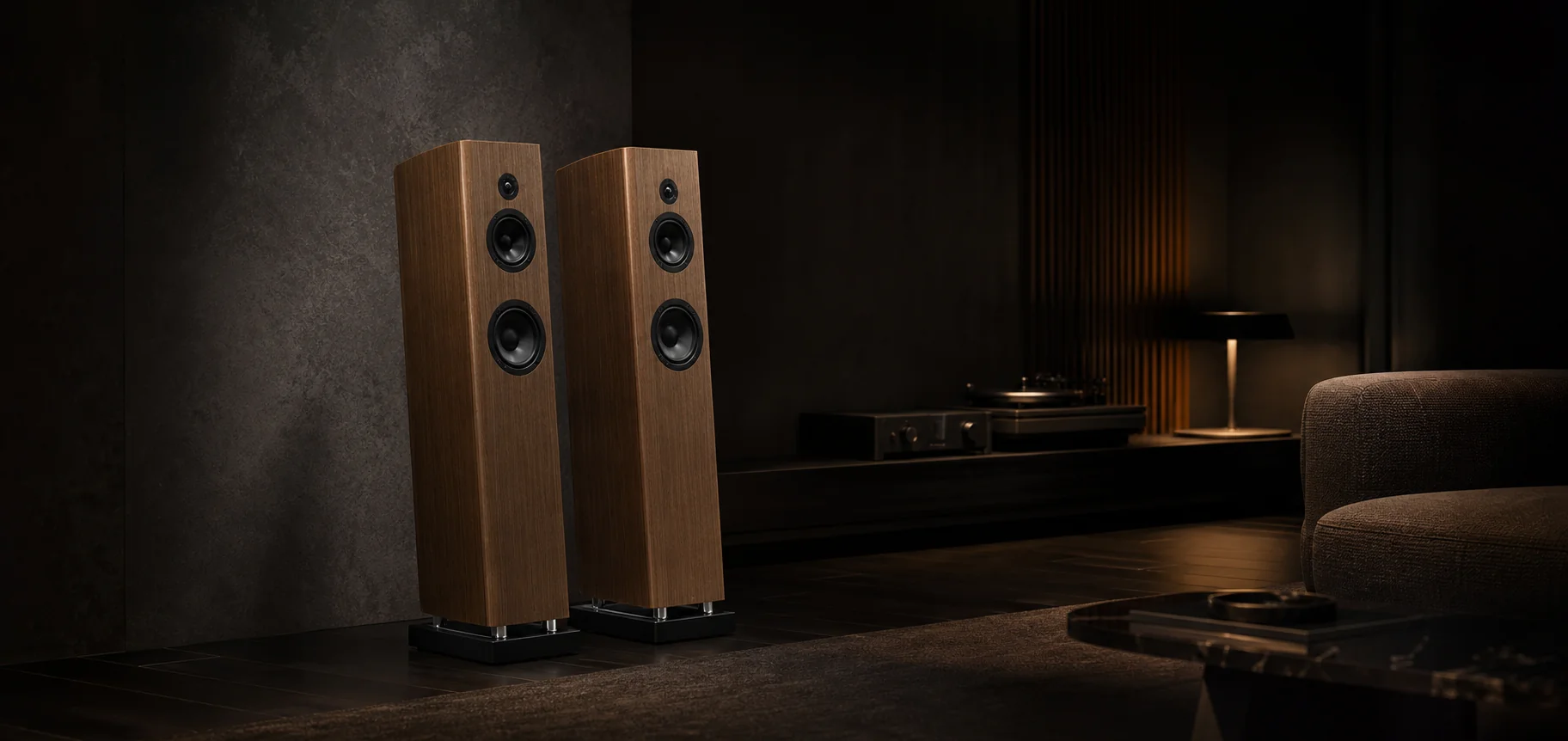
Pylon Audio Diamond 25 series 1: the polished, room-friendly floorstander that made Pylon look more expensive than it was
The first Diamond 25 combined a warm, room-friendly presentation with stage scale and build quality that made it feel significantly underpriced. A used-market buy whose sonic case still holds up.
Pylon Audio Diamond 25 series 1
Intro / Lead
The first-generation Pylon Audio Diamond 25 is one of those products that becomes harder to read correctly once a successor arrives. In 2026, that is exactly the danger. The later Diamond 25 mkII is newer, louder in the discourse, and widely described as the more dynamic and transparent revision. That makes it easy to flatten the original into a mere draft version of something better. The evidence suggests a more interesting story than that.
When the first Diamond 25 entered the market in 2015, it was not presented as a stripped-down compromise box. It was the more compact, more domestically plausible partner to the larger Diamond 28, built for rooms that wanted real floorstander scale without the physical burden and appetite of the bigger model. Its official specification was respectable rather than theatrical: a 2.5-way design, 4-ohm nominal impedance, 88 dB claimed sensitivity, 40 Hz - 20 kHz bandwidth, two 15 cm SEAS-based mid/bass drivers, one 19 mm Scan-Speak tweeter, a narrow rear-leaning cabinet, and a price that lived around PLN 5,500-6,690 depending on date and finish. On paper, none of this screams revolution.
What made the speaker matter was how completely it seems to have outperformed the modesty of its raw facts. Across the review base, the first Diamond 25 is repeatedly described as coherent, mature, spacious, beautifully made, and unusually refined for the money. Not the most aggressive. Not the sharpest. Not the most overtly exciting in the first five minutes. But a speaker whose balance, cabinet quality, and room-friendly scale made many reviewers talk as if it belonged a class above its asking price.
That still matters in 2026, especially because the model now lives mainly on the used market. HifiShark traces and marketplace echoes from late 2025 into early 2026 suggest pricing around PLN 4,190-4,400 in Poland, with scattered European traces near EUR 1,000-1,200, all heavily dependent on condition, finish, and region. At that level, the original Diamond 25 no longer competes only against its own launch peers. It competes against newer stand-mount systems, older British and Scandinavian floorstanders, and the buyer's own temptation to stretch to mkII.
This article argues that the first Diamond 25 still makes coherent sense, but only if we read it correctly. It is not the bargain version of a more modern speaker. It is a distinct proposition: a compact floorstander with unusually strong craftsmanship, strong vocal credibility, a soundstage bigger than its footprint suggests, and a tonal balance built around musical continuity more than adrenaline. That will make it deeply appealing to some listeners and a little too polite for others.
This text is a synthesis of manufacturer material, archived reviews, measurements, owner discussion, and used-market traces. It is not a first-hand listening report. Its task is not to crown a winner. It is to identify what the first Diamond 25 consistently was, what it did particularly well, and what sort of buyer should still care.
Device DNA
The first defining trait of the original Diamond 25 is coherence before fireworks. The speaker's recurring achievement is not one spectacular party trick. It is the way bass, midrange, and treble seem to join into a convincing whole. Several sources use different language for the same idea: natural, mature, balanced, dense, civilised, musically complete.
The second trait is room-friendly scale. This is not a tiny speaker pretending to be a floorstander. Multiple reviews hear real stage width and depth, enough low-end reach to give recordings body, and enough physical authority that the sound can feel substantially larger than the cabinet suggests. But unlike Diamond 28, the 25 is repeatedly treated as the model for normal living rooms rather than for aspiration by square meter.
The third trait is cabinet quality as substance. Build quality is not an afterthought in the story of this speaker. Reviewers keep returning to the finish because it was central to the shock of the product. The original Diamond 25 made people rethink what a mid-priced Polish floorstander could look like. More importantly, the quality of the cabinet does not seem to have been used as camouflage. The sound was good enough to support the visual claim.
The fourth trait is safe voicing with real class. Later retrospectives on mkII describe the original as pleasant, balanced, coherent, and hard to criticise, but also somewhat restrained. That is probably the fairest summary. The first generation was voiced to keep the door open to many recordings and long sessions. Its safety was not cheap caution. It was the caution of a product that wanted to be lived with.
Quick Decision Profile
Three strongest strengths:
- A cabinet and finish standard that gave the speaker a more expensive aura than its price bracket.
- Natural tonal integration with especially strong vocals and a convincing sense of stage and image depth.
- Practical floorstander scale for medium-size rooms without the size burden of larger siblings.
Three main reservations:
- The very bottom end is not always held with perfect discipline, especially if the partnering electronics are too soft.
- Listeners chasing bite, edge, and upfront excitement may hear the speaker as too careful.
- The later
mkIIexists for a reason; buyers wanting more attack and transparency may prefer the newer path.
Who it is for:
This speaker is best for someone who wants a tasteful floorstander with a real furniture-grade presence, listens for hours rather than minutes, and cares more about proportion, body, and stage than about sonic pyrotechnics. It is less ideal for the buyer who thinks "engaging" means vivid top end and immediate transient shock.
Build and Technical Specification
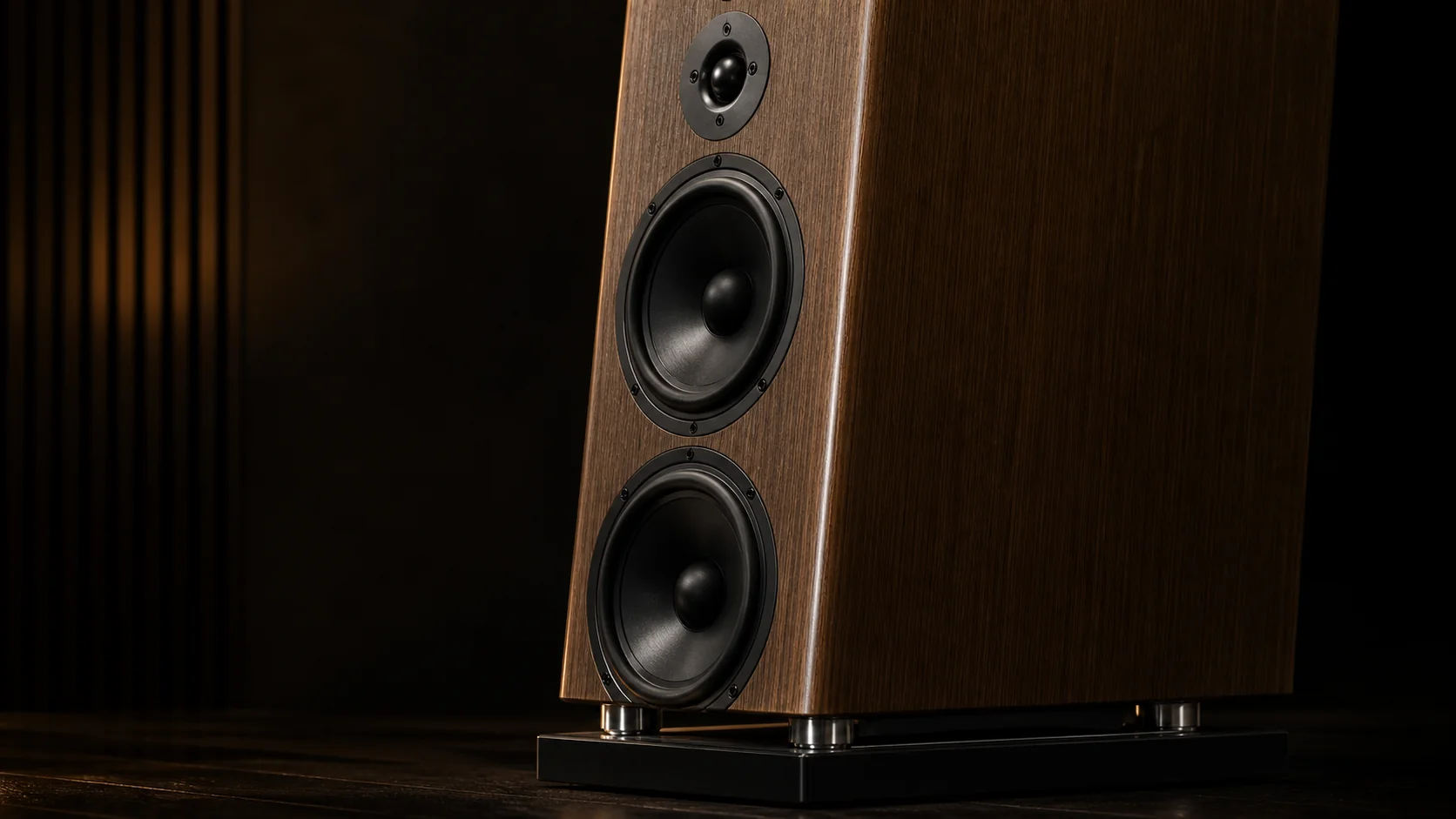
Technically, the first Diamond 25 is a study in doing familiar things well. It uses two 15 cm SEAS-based drivers in a 2.5-way arrangement and a 19 mm Scan-Speak textile dome tweeter. The cabinet is slim, rear-ported, and tilted back. The crossover is direct-mounted. Internal construction relies on MDF panels, added bracing, bitumen damping, and sheep's wool. The speaker sits on a stabilising plinth that also contributes strongly to the visual identity.
None of those choices are radical, but the combination matters. Pylon's archived description makes clear that the speaker was meant to inherit the sonic family of Diamond 28 while fitting better into smaller homes. The smaller cabinet did not imply a stripped product. On the contrary, many reviews focus on the exact opposite: that the model felt carefully engineered and unusually complete at the money.
The official figures list 4 ohms, 88 dB, 40 Hz - 20 kHz, 100 W nominal power, 200 W maximum power, and dimensions of 165 x 942 x 290 mm. Weight is 19 kg per speaker, which is substantial enough to imply real cabinet seriousness while still remaining manageable in domestic ownership. The manufacturer also recommended rooms of 18-32 m2, and that range broadly fits the review record.
The measurement data from Audio.com.pl is especially useful because it grounds the spec sheet in reality. Sensitivity measured closer to 86 dB, not the full claimed 88 dB. Impedance behaviour was still presented as fairly civil, meaning the speaker is not some deceptive 4-ohm monster in polite clothing. The same source also found bass extension around 35 Hz at -6 dB, which helps explain why so many writers were struck by the model's scale.
There is one quiet technical point that becomes important later: the speaker's smallish tweeter and voicing choices seem to contribute to a tonal balance that several writers hear as open but not bright, detailed but not etched. That is consistent with the product's general philosophy. It does not try to fake resolution by hyping presence or treble. It would rather stay intact.
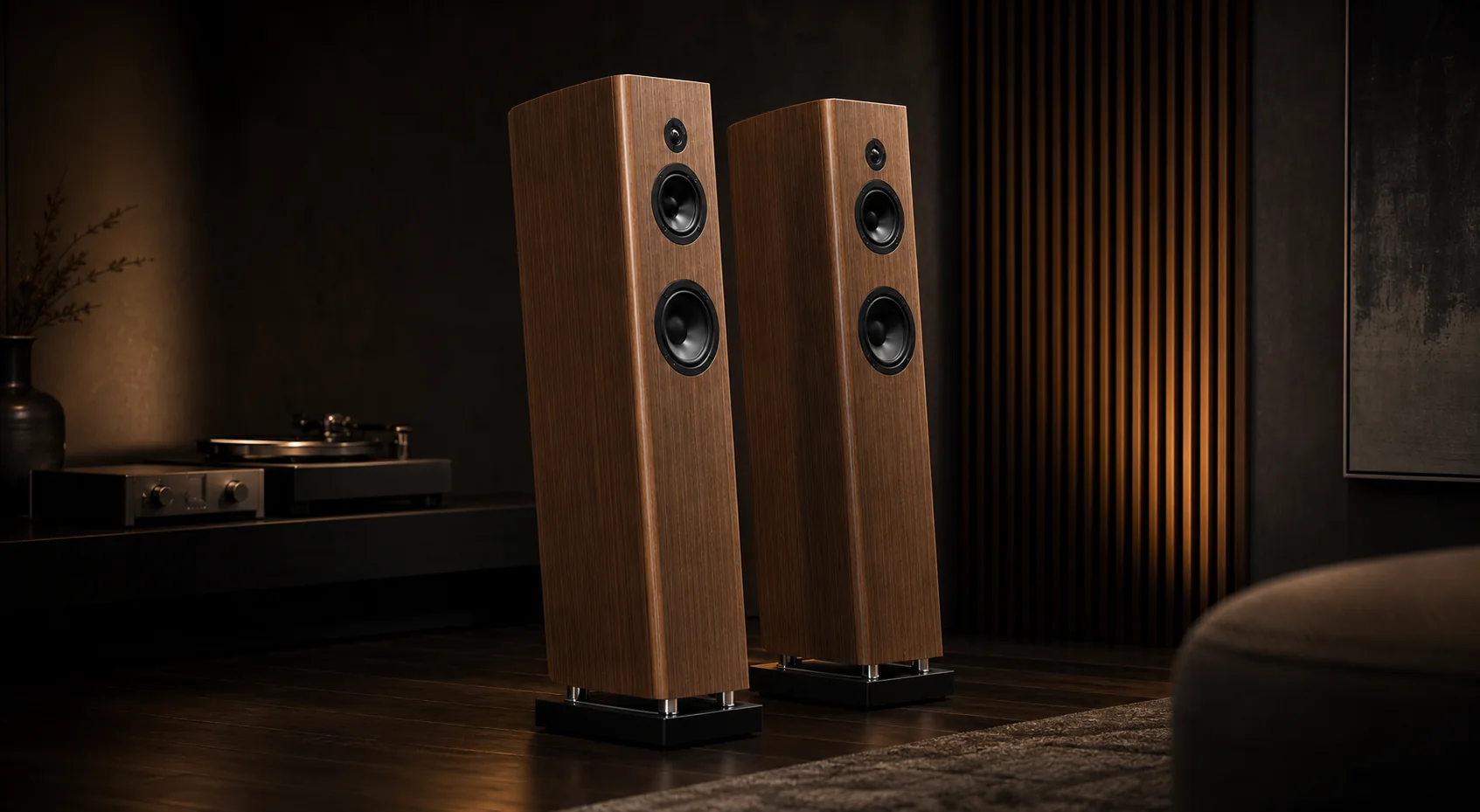
Finally, ownership details matter because they shape the product's market identity even in used form. Magnetic grilles, a clean front baffle, single binding posts, multiple wood and lacquer options, and an elegant plinth — all documented on the Pylon Audio archival product page — made the speaker easy to imagine in a lived-in home. That practical elegance is part of the product's character, not a cosmetic footnote.
What Reviewers Say
The strongest professional consensus around the first Diamond 25 is that it sounded more grown-up than its price suggested. Reviewers do not all use the same language, but they converge on a few points with notable stability: high build quality, natural balance, spacious imaging, and a sound that is expressive without becoming sharp.
Audio.com.pl describes the speaker as dense, juicy, plastic, yet also precise and transparent, with nicely decaying bass, natural colour, and subtle detail. That is one of the better summaries in the source base because it captures the speaker's dual nature. This is not a dry neutralist. But neither is it a vague warm bath. The review also notes that the bass is not the most massive or hardest-hitting in the field, yet still extends impressively and sounds believable. That distinction is essential. The speaker's bass argument is not brute force. It is proportion and scale.
StereoLife frames the product in a more lifestyle-practical way. For that reviewer, Diamond 25 is the Diamond for ordinary living rooms, not because it is small in ambition, but because it is the best balance of footprint and payoff. The tonal balance is treated as close to ideal, with a slight favouring of the midrange that turns vocals into a strength. The same review also suggests that a little wall support can produce bass "like a good subwoofer," which is enthusiastic language, but it supports the same broad theme: size-to-scale ratio is one of the model's main achievements.
Stereo i Kolorowo is more openly rhapsodic, yet still useful. It hears the speaker as mature, harmonised, tonally saturated, dynamic, spacious, and highly musical, with excellent behaviour at both low and high listening levels. Perhaps the most practically interesting part of that review is its amplifier section. Strong transistor integrated amplifiers are praised as ideal partners, but tube options are also treated as viable, even symbiotic, as long as the quality level is high enough. That reinforces the idea that Diamond 25 is not brutally amplifier-hostile, only quality-aware.
High Fidelity introduces the most valuable caution. This review strongly praises the speaker's ability to build large, organised space and to sound open without becoming harsh. It even states that these are not romantic speakers in the soft-focus sense. At the same time, it argues that the speaker benefits from a strong transistor amplifier and notes that the lowest bass is not always equally controlled. This matters because it stops the article from turning into a simple value myth. The original Diamond 25 had boundaries, and low-end discipline is one of them.
The later Qobuz review, arriving years after launch, hears many of the same virtues: wide bandwidth, deep soundstage, substantial bass, pleasant vocals, and generally relaxing long-session behaviour. It also hears a midrange that can feel slightly closed-in and a top end that will not satisfy lovers of maximum openness. That later criticism is helpful because it shows how the product reads once the novelty wears off. It still makes sense, but it makes sense for a very particular sort of listener.
The retrospective StereoLife mkII piece adds a final layer. Looking back, the first generation is described as natural, balanced, coherent, slightly warm, and safe, but not especially adventurous. That does not cancel the earlier praise. It contextualises it. The first Diamond 25 was successful not because it chased drama, but because it delivered maturity, civility, and quality so early in Pylon's evolution.
Community Voice
The community evidence around Diamond 25 is narrower than the professional layer, but its consistency is striking. On Polish forums — chiefly the Audio.com.pl Diamond 25 thread — owners and prospective buyers repeatedly return to the same questions: what amplifier controls it best, what room size makes sense, and whether one should aim for greater musicality or greater grip in a matching system.
That alone says something useful. Nobody seems preoccupied with whether the speaker is too bright, too metallic, or too aggressive. The anxiety, where it exists, concerns exactly the opposite direction: how to make the most of its bass, energy, and system potential. That is highly consistent with the reviews.
Forum threads show the speaker being considered with NAD 368, Audiolab 6000A, Marantz PM7000N, Hegel H90, Cambridge CXA81, and Lyngdorf TDAI-1120, among others. These are not random matches. They are the kinds of amplifiers people choose when they believe a loudspeaker will reveal real differences in grip, dynamics, and tonal balance. The community therefore places Diamond 25 in an interesting middle tier: revealing enough to reward care, civil enough not to become nerve-racking.
Room sizes in these discussions often fall around 17-30 m2, again neatly reinforcing the official guidance. The model is not treated as an apartment toy. But it is also not treated as a speaker that automatically needs a giant dedicated room. Its entire practical appeal depends on living in that domestic middle ground.
Comments under the Stereo i Kolorowo review add smaller but telling details. Questions about comparisons with Triangle, Tannoy, and Onkyo pairings show that buyers saw the speaker as a real alternative to mainstream aspirational floorstanders, not merely as a patriotic local curiosity. Even years after publication, users still asked whether modest or mid-tier amplifiers were enough, and the recurring answer was revealing: yes, but the speaker deserves better if you can afford it.
The Reddit r/audiophile trace is weaker evidence, yet it contributes to the same picture. The question there is again not whether the speaker has enough personality, but which amplifier character will suit it best. This is a loudspeaker people seem to want to tune, not to rescue.
Two Radars
Sound radar
Neutrality: 7/10
Balanced and civilised, but not aloof.Warmth: 7/10
Pleasantly generous without turning syrupy.Macro dynamics: 7/10
Convincing scale, though not high-theatre violence.Micro dynamics: 7/10
Enough detail to track better front-end changes.Bass control: 7/10
Good overall, with some caution at the deepest edge.Midrange density: 8/10
Vocals and acoustic material remain a core strength.Treble openness: 6/10
Clean and refined, but not a "spotlight" treble.Soundstage scale: 8/10
Repeatedly praised and central to the product's identity.Poor-recording tolerance: 8/10
Enjoyment is part of the design brief.
Practical radar
Amplifier friendliness: 7/10
Fairly manageable, though clearly better with quality power.Room flexibility: 8/10
Strong case for medium domestic rooms.Placement tolerance: 7/10
Rear porting matters, but the model is not exceptionally difficult.Low-volume vitality: 8/10
Strong evidence of good behaviour below show levels.Build and finish: 9/10
A major selling point then and now.Ownership practicality: 8/10
Serious enough to satisfy, civil enough to live with.
For Whom Especially
The first and clearest fit is the listener who wants a music-first floorstander for real life. This buyer does not need a speaker that wins every short demo by shouting its virtues. They want one that sounds complete, credible, and emotionally available across long sessions and mixed recordings. That is very much where the original Diamond 25 seems strongest.
The second fit is the medium-room system builder. Not everyone has the space or appetite for the larger Diamond models. The first Diamond 25 makes sense precisely because it gives a strong impression of scale without demanding the sort of room that turns a purchase into architecture.
The third fit is the used-market aesthete. A second-hand loudspeaker is not just about sound per euro. It is also about whether the thing still looks like an object worth owning. Here the first Diamond 25 is unusually persuasive. Good examples still have the power to look expensive in a way many rivals do not.
The fourth fit is the buyer who wants upgrade headroom without punishment. These speakers seem to reward stronger electronics, but they are not such unforgiving microscope tools that average listening becomes work. That makes them easy to build around over time.
Who should probably look elsewhere? Anyone who treats attack, air, and incisiveness as the whole point of hi-fi. Anyone hoping the speaker will replace careful system matching with sheer charm. And anyone who really wants mkII energy but is trying to talk themselves into the older version on price alone.
Market Positioning and Real Alternatives
The simplest and most honest internal comparison is Diamond 28. The larger model offered more low-end authority and more scale, but it also made heavier demands on room and placement. The first Diamond 25 earns much of its status by refusing that trade-off. It is not the "cheap Diamond." It is the domestically rational Diamond.
Against more overtly lively or brighter competitors such as some Triangle or Tannoy alternatives, the Pylon's defence is clear. It offers more cabinet gravitas, more tonal ease, and a presentation built around coherence rather than edge. That will not suit every listener, but it is a serious profile, not a compromise by default.
Against more expensive references such as Audio Physic Classic 8, the argument shifts. Here the first Diamond 25 does not claim to dominate. It claims to give unusually much of the spatial and visual maturity associated with more expensive European floorstanders while staying dramatically more accessible.
On the used market in 2026, the position becomes even more attractive if pricing remains sensible. At around PLN 4,200, the original Diamond 25 can tempt buyers who would otherwise be choosing between new stand-mounts and older floorstanders of less obvious object quality. That does not make it automatically the best answer. It makes it one of the more coherent ones.
Version Line
The first Diamond 25 was publicly visible in 2015 and quickly became a key part of Pylon's rise from budget competence toward genuine aspirational credibility. It sat below Diamond 28 in size, but not in seriousness. In many homes, it was the more logical product.
The later Diamond 25 mkII, reviewed in 2024, changed more than its name suggests. According to Pylon and the surrounding review material, the revision brought altered drivers, changed geometry, revised damping, new placement of the bass/mid units, and a more ambitious tonal result. This is important because it reframes the original model as a speaker prized for ease, coherence, and musical hospitality rather than for excitement.
That should shape purchase logic today. If one wants the calmer Diamond, the first generation remains defensible. If one wants the more modern, more energetic interpretation of the same platform, the revision has a real case. The point is not to collapse them into one long product. It is to understand why each exists.
System Synergy and Room Fit
The best way to think about amplification for the first Diamond 25 is that quality matters more than brute fear. Audio.com.pl did not treat it as a savage load. The speaker's 4-ohm rating appears honest, and its impedance behaviour remains relatively well-mannered. But the better sources also show that stronger, cleaner amplification helps it become more itself.
That matters most in bass control and tonal poise. If the amplifier is too soft, the lowest end may relax more than ideal and the speaker's pleasantness may drift too far into comfort. With stronger control, the virtues stay intact while the bass and image structure sharpen. This is exactly why High Fidelity leans toward strong transistor pairing.
At the same time, the speaker is not ideologically anti-tube. Stereo i Kolorowo found genuine value in tube pairings, especially where natural tone and saturation were concerned. The broader lesson is that Diamond 25 is not so narrow in temperament that only one system philosophy works. It simply rewards a system that understands its priorities.
Room fit is an equally strong part of the case. Everything about the product makes more sense in a room that wants a real floorstander but not a giant one. Medium living rooms are the natural habitat. Smaller rooms are not automatically excluded, especially if placement is sensible and the user does not demand nightclub levels. Larger rooms may still enjoy the speaker, but this is where Diamond 28 begins to reclaim its reason to exist.
The rear port means one should not treat placement casually, but the sources do not portray the speaker as dramatically fussy. Several imply that some wall support can actually work to its benefit. That is a practical advantage in homes where every speaker cannot sit a full metre into the room.
Low-volume listening looks like another quiet strength. Because the speaker is built around tonal wholeness rather than hyped brilliance, it can remain believable and emotionally legible when not pushed hard. That may be one of the least glamorous but most important reasons it has remained attractive.
Methodology and Sources
This article is a source-based synthesis, not a first-hand review. It draws on archived manufacturer material, professional reviews, accessible measurements, community traces, and used-market data.
Its main limits are clear. Measurement coverage is meaningful but narrow. Some later understanding of the first generation comes through retrospective comparison with mkII. Community evidence is practical but not vast. Used-market pricing is date-sensitive. Within those limits, however, the portrait is stable enough to support a clear conclusion.
The first Pylon Audio Diamond 25 was not simply a prelude to mkII. It was a highly coherent, highly polished, room-friendly floorstander whose strongest virtues were maturity, scale, finish quality, and the ability to sound expensive without behaving temperamental. Its weaknesses were equally clear: a certain tonal caution, only moderate appetite for sheer excitement, and bass control that benefits from careful partnering. Read on those terms, it remains a very sensible and very likable used-market speaker. Editorial recognition came early, including a High Fidelity 2017 Annual Award.
The full structured source list — with per-source notes on what each contributes — is available in the Sources widget on the right.