
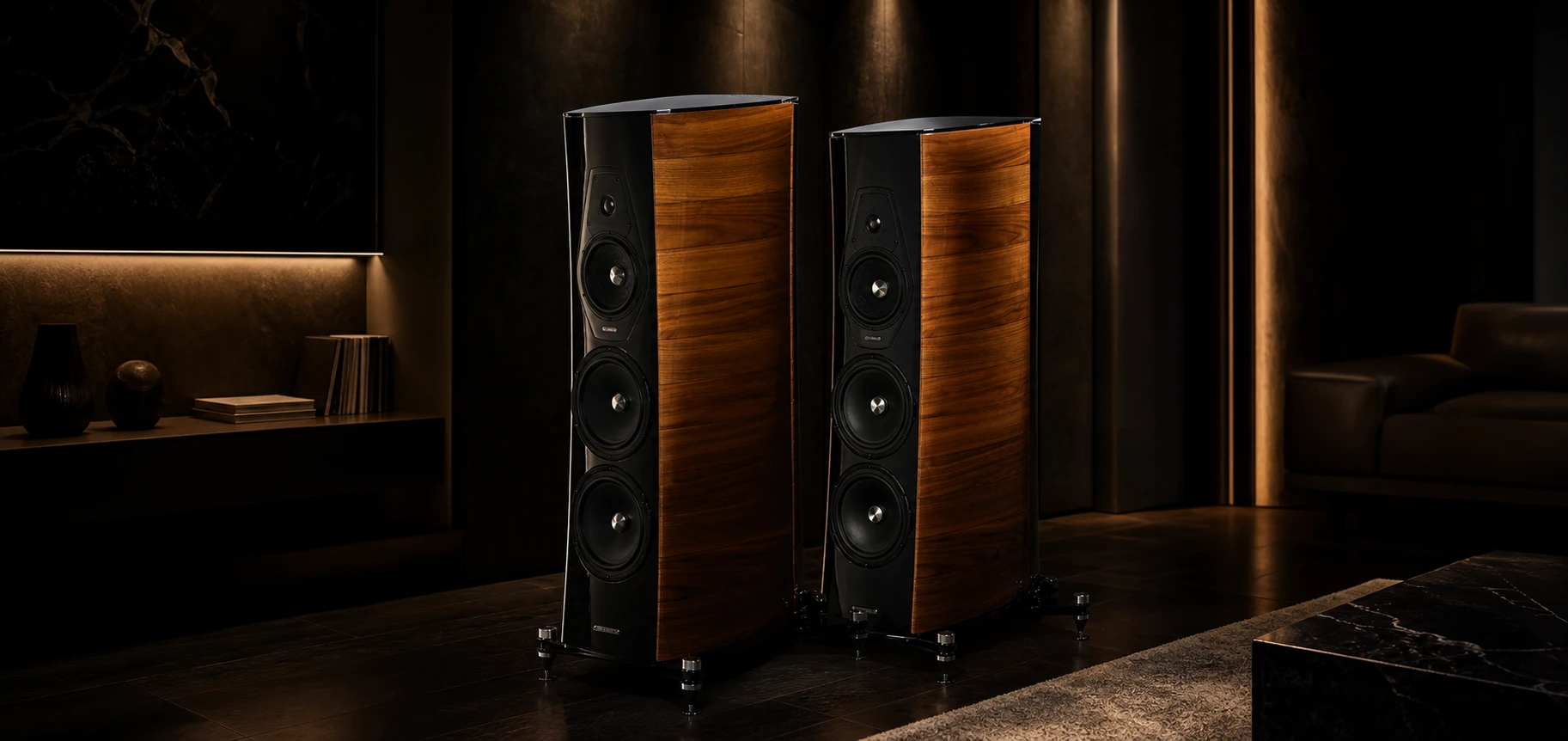
Sonus faber Amati Futura: the point where Italian grandeur turns into real full-range authority
The Amati Futura adds real bass discipline and full-range authority to Sonus faber's signature warmth. On the used market, it represents one of the discontinued Italian flagships whose acoustic case still holds when examined against the evidence.
Sonus faber Amati Futura
Intro / Lead
The Sonus faber Amati Futura, launched at roughly USD 36,000 per pair and seen on the used market between November 2025 and February 2026 at roughly EUR 11,000-14,200 depending on condition and region, belongs to a class of loudspeakers that can be misunderstood in two opposite ways. One bad reading says it is simply an old luxury Sonus faber: gorgeous wood, lush tone, and too much romance for anyone who values control. The other bad reading says it is merely a stepping-stone on the way to Amati Tradition and the current Amati G5, interesting mostly as a cheaper older nameplate. The source base — including the Stereophile review, The Absolute Sound coverage, and used-market traces aggregated by HifiShark — suggests something more specific and more useful than either shortcut.
Amati Futura matters because it appears to be one of the moments when Sonus faber made a serious effort to keep the beauty, tactility, and tonal saturation that had built the brand's reputation while tightening the low end, enlarging the sense of physical authority, and pushing the whole design further toward modern full-range competence. That does not make it a disguised studio monitor, and it does not make it a "better Wilson" or an "Italian Magico." It does mean that reducing it to a soft-focus luxury object misses the point.
That matters even more in 2026 than it did when the speaker was previewed at CES 2011. Nobody sensible is cross-shopping Amati Futura against its original launch context alone. Today it lives in the used market, where it competes not with new price tags but with other mature high-end designs whose strengths are clearer and whose compromises are often better understood. In that environment, a beautiful reputation is not enough. A discontinued flagship has to justify its space, its amplifier demands, its room demands, and its resale logic.
The evidence suggests that Amati Futura often can. Professional reviews consistently describe a loudspeaker with large-scale imaging, rich and expressive midband reproduction, significantly firmer bass behavior than older Sonus faber stereotypes would lead you to expect, and enough system selectivity to make amplifier choice a real part of the product rather than an afterthought. It is not a universal solution. It is not the last word in raw neutrality. It is also not a relic that only survives on cabinet craftsmanship. Its continued relevance comes from being a recognizably Sonus faber loudspeaker that seems to have grown up.
This article is a synthesis of manufacturer material, archived specifications, professional reviews, independent measurements, community discussion, and used-market traces. It is not a first-hand listening report. Its purpose is to identify what Amati Futura consistently is, where the evidence is thinner, and for what kind of buyer this still makes coherent sense.
Device DNA / constitutive traits
The first defining trait of Amati Futura is mature warmth. This is not a cold loudspeaker, and the source base does not support pretending otherwise. But the warmth is repeatedly framed — across Stereophile, The Absolute Sound and Positive Feedback — as structured and adult rather than soft for its own sake. Reviewers do not generally describe it as a fuzzy nostalgia machine. They describe it as rich, embodied, and tonally generous while still aiming at resolution and order.
The second defining trait is scale without looseness. A recurring thread across the professional material is that Amati Futura does not merely sound big because it is physically big. It sounds big because it projects mass, image size, and low-frequency foundation in a way that feels deliberate. That is a very different claim from "there is a lot of bass." The more important point is that the bass is usually treated as one of the places where this generation advanced the line.
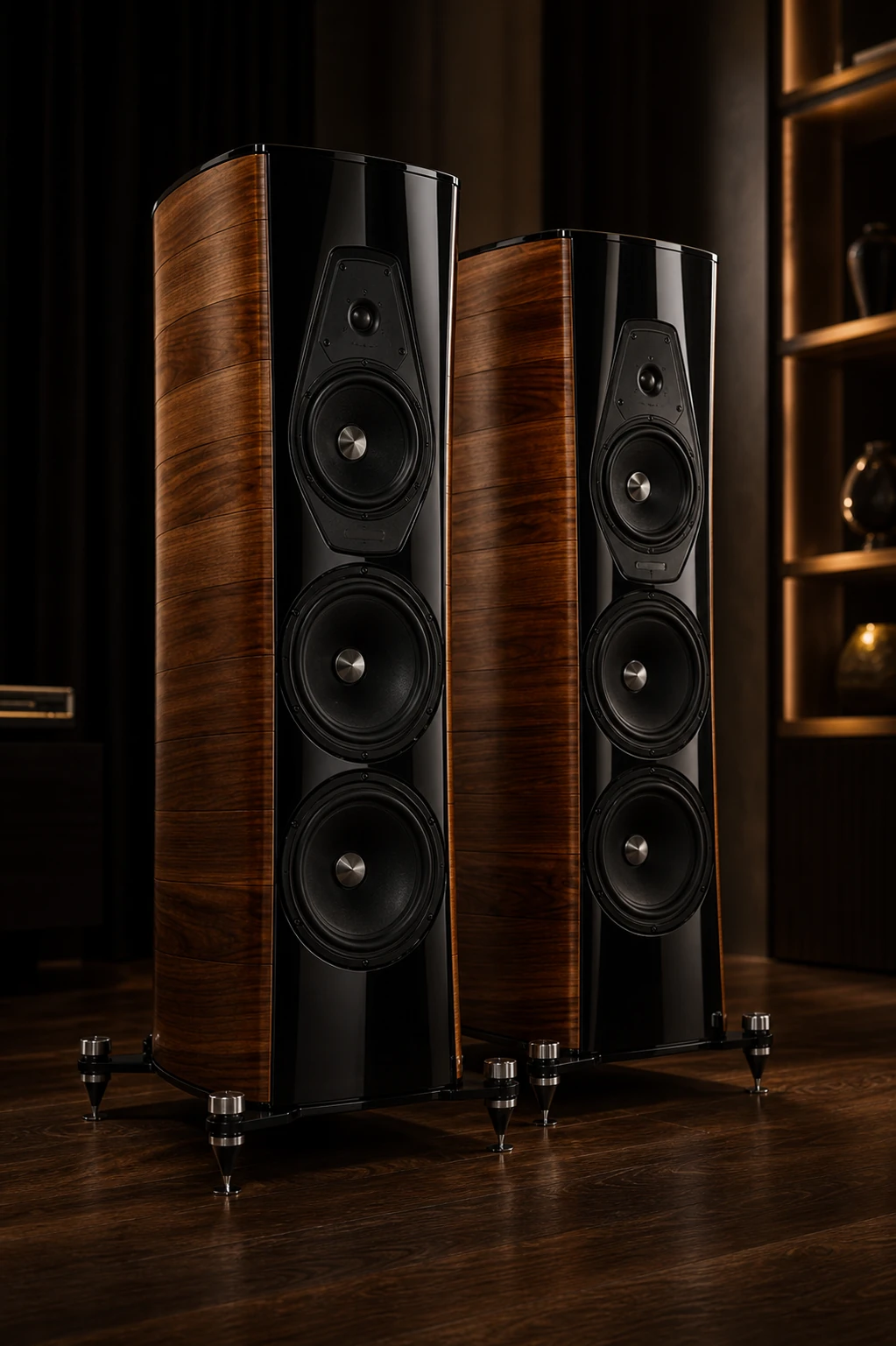
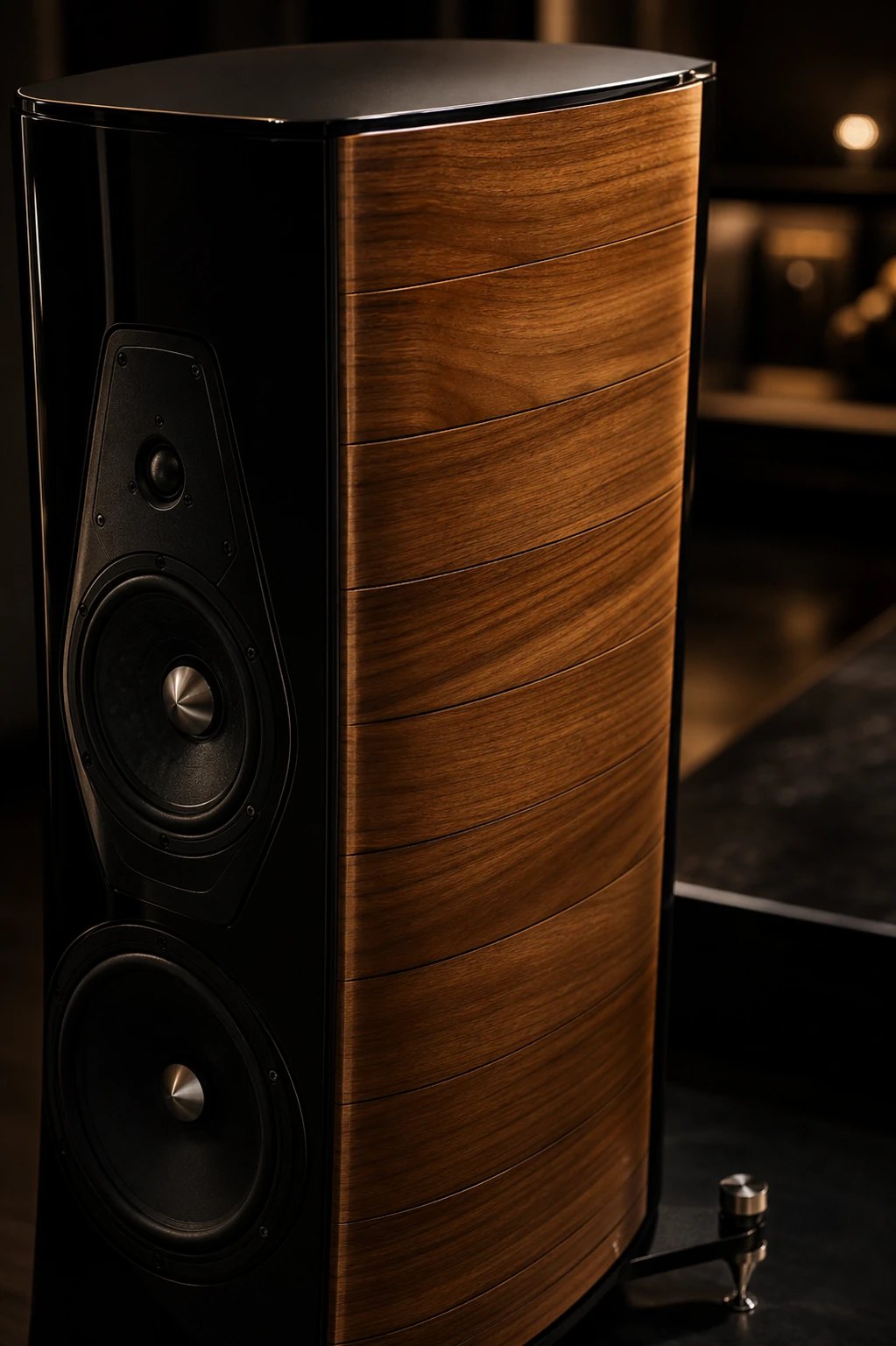
The third trait is luxury object presence. Many high-end loudspeakers are expensive. Not all behave like designed objects in the room. Amati Futura does. The cabinet work, materials, and visible craftsmanship — which the Sarte Audio long-form piece treats as inseparable from the listening case — are not incidental side notes; they are part of why people still remember this speaker. But that aesthetic presence is not the whole case. The reason it matters is that the sonic and physical identities appear aligned rather than contradictory.
The fourth trait is system selectivity. Measurements and listening reports both point in the same direction: this is not a random-friendly loudspeaker. It rewards current delivery, control, and room attention. That does not mean it is brutally difficult in the way some ultra-demanding flagships are. It does mean that a buyer who thinks the cabinet beauty alone guarantees an easy partnership is setting themselves up for an expensive misunderstanding.
Quick decision profile
Three strongest strengths:
- Rich, articulate midrange and large-scale presentation that make music feel physically inhabited rather than merely outlined.
- Bass authority and full-range composure that move the speaker beyond the older caricature of Sonus faber as mainly a midrange-and-beauty brand.
- Exceptional finish, material quality, and long-session listenability without obvious glare.
Three main caveats:
Amati Futurais not a casual amplifier match; real control matters.- In the wrong room or with already soft electronics, its grandeur can drift toward stateliness instead of life.
- Used-market value depends heavily on condition, transport risk, and pricing discipline, not just on reputation.
Who it is for and who it probably is not for:
Amati Futura makes the most sense for a listener who wants a full-range high-end loudspeaker with genuine body, image scale, beauty of finish, and less tonal tension than many overtly "monitor-like" rivals. It makes less sense for someone whose first priority is maximum treble illumination, a compact-room-friendly load, or a ruthless form of neutrality that strips away cabinet personality as an aesthetic goal.
Build and technical specification
Amati Futura is a large 3.5-way floorstanding loudspeaker positioned in Sonus faber's upper high-end range of its era. Even before getting into the language around voicing, the physical facts matter. Each loudspeaker weighs roughly 55.5kg according to the HifiEngine specification archive, which immediately tells us that this is not one of those visually elegant towers whose engineering substance disappears when you get close. It is a substantial design in every practical sense: mass, footprint, shipping burden, placement consequence, and system seriousness.
The official and archival specification picture places Amati Futura at a nominal 4 ohm impedance. On its own, that phrase means almost nothing; plenty of speakers wear a 4-ohm label. The measurement context is what makes it useful. Stereophile's laboratory work places sensitivity at roughly 88.1dB, which is respectable but not an invitation to treat the speaker as especially easy. More importantly, the impedance behavior and electrical characteristics support the broader reviewer consensus that amplifier grip matters. This is a luxury loudspeaker, but not a lazy load.
Construction details also matter because Sonus faber did not position Futura as merely a cosmetic revision. The cabinet architecture, damping emphasis, driver integration, and low-frequency behavior were all part of the case for the model. Across the review base — including Positive Feedback's long-form coverage — the design is repeatedly framed as a step beyond the softer, more obviously romantic historical stereotype of the brand. That does not mean Sonus faber abandoned sculptural cabinet work, leather, wood, and object-level tactility. It means those traits were paired with a stronger argument about resonance control, bass discipline, and full-range coherence.
This is why the cabinet discussion cannot be separated from the sonic discussion. In some brands, lavish external finish can feel like an expensive wrapper around a more ordinary acoustic core. The available evidence suggests Amati Futura is not that kind of product. The curved form, complex enclosure, mass, and mechanical treatment all appear tied to Sonus faber's attempt to reduce the "beautiful but a little loose" narrative that older critics sometimes attached to the marque. Dealer documentation such as the KJ West One delivery note reinforces how the finish work was treated as a core selling point.
The visible proportions are also important in practical terms. Amati Futura is not a visually disappearing mini-tower. It is a room-defining object. That has two consequences. The first is psychological: buyers are paying not just for sound, but for a loudspeaker that behaves like furniture-grade sculpture without becoming kitsch. The second is acoustic: because the speaker is physically substantial and voiced for scale, room interaction is not a fine-print issue. It belongs in the main argument about whether this is the right purchase.
The driver complement and crossover strategy, as discussed across the professional coverage, support the same overall conclusion. Sonus faber's aim was not simply sweetness. The target appears to have been a broader-bandwidth, more controlled, more dynamically persuasive loudspeaker that still kept the harmonic generosity and image richness the brand's admirers expect. That is why Amati Futura is often described as more modern or more "grown up" than earlier Sonus faber flagships, even by writers who still hear a distinctly Italian sense of tonal bloom.
None of this should be mistaken for a claim that specifications alone predict the result. They do not. But the build story matters here more than it does with some rivals because the speaker's identity is inseparable from its materials and mechanical execution. A reader who buys the idea that Amati Futura is just another pretty Sonus faber probably has not paid enough attention to the design intent. A reader who thinks the elegant finish is irrelevant to understanding the product has made the opposite error. In this case, industrial design and acoustic ambition appear to be pulling in the same direction.
There is one more practical implication of the specification story: ownership friction. Speakers this heavy and elaborate do not behave like casual purchases on the secondary market. Packaging, spikes, cosmetic condition, and transport history matter more than they do with smaller, more anonymous designs. That becomes part of the technical argument in 2026, because a used flagship loudspeaker is never just a sound purchase. It is a logistics purchase too.
What reviewers say
The professional consensus around Amati Futura is interesting precisely because it is not flat. Writers do not all describe the speaker in exactly the same emotional register, but they converge on several important facts. First, it is repeatedly heard as a large-scale, physically grounded loudspeaker with strong image height and depth, a generous but disciplined midband, and bass behavior that feels more modern and more controlled than the older Sonus faber stereotype would suggest. Second, it is not generally described as a "speed first" or "knife-edge neutral" design in the manner of some of its most obvious rivals. Third, amplifier and system context are treated as central, not incidental.
Stereophile is especially useful because it helps stabilize the conversation around what the speaker is not. The review context strongly suggests that Amati Futura should not be reduced to prettified warmth. The point is not that it suddenly became an antiseptic transducer. It did not. The point is that its authority, bass extension, and image scale were taken seriously enough that the old stereotype stopped being sufficient. That is one of the most important conclusions in the whole source base: not that Sonus faber abandoned beauty, but that beauty was no longer the only story.
The Absolute Sound pushes a related idea from a slightly different angle. Instead of treating the loudspeaker as an exercise in brand romance, the review language frames it as a convincing full-range proposition with the kind of tonal completeness and physical ease that make a speaker feel expensive in use, not just in appearance. That distinction matters. Plenty of costly loudspeakers advertise luxury through materials but collapse into a narrower sonic identity. Amati Futura seems to have avoided that trap often enough that reviewers discussed it as a genuine contender in its class, not just a house-flavored indulgence.
Positive Feedback is particularly valuable because it leans into the material and craft side without losing the sound argument. The cabinet work and finish are treated as exceptional, but not as compensation for weak acoustic results. Instead, the sense is that the tactile and visual richness are joined by an equally deliberate effort to give the speaker more grip, structure, and low-frequency confidence. That does not erase subjectivity. What it does is make it much harder to dismiss the product as a lifestyle object with audiophile pricing.
The SoundStage! Ultra feature helps articulate the old/new tension inside the Sonus faber identity. It is useful not because it creates a neat verdict, but because it shows why Futura remains memorable. The speaker appears to sit at a pivot point where Sonus faber kept enough of its historical sensuality to remain recognizably itself while also signaling that it no longer wanted to be typecast as beautiful but technically soft. That is a more interesting story than simply saying it is warmer than Magico or more luxurious than Wilson, even though those comparisons do lurk in the background of the discourse.
The tonal center of gravity emerging from the professional material can be described as rich but not vague. Vocals and instruments with strong body benefit from that. The midrange is repeatedly treated as a strength, but not in a one-note "liquid midrange" sense. What matters is that the speaker seems able to preserve color and flesh without sounding shapeless. That is a harder achievement than promotional audio language usually admits.
Bass is the second major consensus zone. It is not merely present in quantity. It is part of why reviewers felt the speaker had matured. A recurring implication is that earlier generations could seduce with tone and finish while leaving some listeners wanting firmer low-frequency discipline. Amati Futura appears to answer that problem directly. The bass is more controlled, more grounded, and more structurally important to the whole presentation. If a reader is trying to understand why this model matters historically, that may be the single most useful answer.
Treble is where the consensus becomes more nuanced. Reviewers generally do not accuse Futura of dullness, but neither do they present it as a top-octave showboat. The upper range is more often framed as refined, integrated, and civilized than as hyper-illuminated. That will be a virtue for some listeners and a limit for others. If someone wants the kind of transient spotlighting that can make a system feel immediately "faster" in a demo, there are competitors more likely to deliver that impression. If someone wants long-session ease without obvious darkness, Futura has a stronger case.
Dynamic behavior is also worth separating into macro and micro terms. The macro case appears strong: scale, weight, and full-range power are all recurrent themes. The micro case is a little more system-dependent. There is enough evidence to support fine nuance and expressive shading, but not enough to claim that Futura is the most explosively reactive or ultra-explicit design of its class. That is not a flaw so much as a statement about priorities. This speaker appears to organize its drama through presence, body, and dimensionality rather than through etched transient excitement.
One more reviewer theme deserves emphasis: the speaker is not treated as electronically indifferent. Writers return again and again to the importance of the amplifier. That is consistent with the Stereophile measurement set and consistent with the general type of loudspeaker this is. It also helps explain why reviewer impressions vary in edge tone. A speaker with this combination of richness, bass extension, and electrical demand can sound magnificently complete in the right chain and merely stately in the wrong one. The disagreement is not random; it maps onto system reality.
The net result is a high-confidence synthesis. Amati Futura is best understood as a large, luxurious, tonally generous loudspeaker that added real bass control, physical scale, and modern high-end seriousness to the Sonus faber formula. It is not neutral in the strictest studio sense, not the easiest to drive, and not universal in appeal. But the evidence strongly supports the idea that it was far more than a beautiful indulgence.
Community voice
The community layer around Amati Futura is not enormous, but it is useful because it sharpens the practical side of the review consensus. Forum and owner discussion rarely argues against the core professional picture. Instead, it tends to confirm it in more operational language: large room, strong amplifier, physical presence, long-term listenability, and a purchase decision that makes sense only when the whole system is already serious.
The Audiogon "Amati Anniversario vs Futura" thread is especially helpful when comparing Amati Futura to other Sonus faber generations. Owner talk repeatedly suggests that the Futura version is not just a cosmetic refresh over earlier Amati models. The recurring takeaway is more control, more confidence, and a less nostalgic sense of voicing. That matters because it reinforces a theme that could otherwise look like review-room mythology. When owners independently echo the idea that the speaker feels more resolved and more disciplined than earlier stereotypes, the claim becomes harder to ignore.
The StereoNET ownership thread contributes a different kind of value. It is less about poetry and more about practical fitting. Participants tend to speak in terms of room scale, matching, and whether the speaker's tonal richness remains lively or turns heavy. That is useful because it pushes against the tendency to treat luxury loudspeakers as self-justifying. In community language, Amati Futura is attractive precisely because it can deliver scale and ease without obvious glare, but it is not self-calibrating. If the rest of the system leans slow, the result can become too stately.
The smaller Reddit r/audiophile traces are weaker evidence, but they still add a contemporary afterlife to the model. Amati Futura tends to surface in comparison discussions that include Magico, Wilson, later Sonus faber models, and occasionally Rockport or Focal. That is revealing in itself. People are not remembering it as a decorative oddity. They are remembering it as a serious choice with a particular aesthetic and sonic profile. Even when those mentions are brief, they confirm that the speaker still sits in active mental rotation among enthusiasts who think in terms of real alternatives.
The used-market layer adds another kind of community signal. Listings and aggregator traces from late 2025 and early 2026 — visible through the HifiShark model page — suggest that Amati Futura occupies the interesting mid-zone between collectible aura and still-usable performance logic. It has not become cheap. It has also not remained close enough to current flagship money to live only on prestige. That is good news and bad news. Good, because the speaker can be bought for far less than its original sticker. Bad, because buyers at these prices have many legitimate alternatives.
That reality changes how owners talk about value. New-product buyers could once justify Amati Futura partly as a blend of sound and object quality. Used-market buyers are sharper. They ask whether the speaker still beats or at least justifies itself against older Wilson, used Magico, strong Focal, or newer Sonus faber offerings higher up the timeline. Community language here becomes more conditional. The speaker's appeal is real, but it is not automatic. Condition, amplifier context, and asking price determine whether the purchase feels smart or merely emotional.
Another useful owner theme is listening fatigue, or rather the relative lack of it. Amati Futura is not typically remembered as an aggressive loudspeaker. That does not mean it is sleepy. It means that its strengths are often described in terms of sustained pleasure rather than first-minute fireworks. Community impressions align with the professional material on this point: the speaker tends to impress over time through body, ease, and completeness, not through treble showmanship or overlit detail.
What the community layer does not really support is any claim that Amati Futura is a universally forgiving room-and-gear solver. That is an important negative result. The speaker may be tolerant of imperfect recordings in a tonal sense, but that is not the same thing as being tolerant of poor setup or weak amplifier control. Owners seem to understand the difference. So should buyers.
Taken together, the community evidence mostly performs a stabilizing function. It does not radically revise the review story. It confirms that Amati Futura is remembered as a serious, large-scale, beautifully made loudspeaker whose value depends on system maturity. That is exactly the sort of confirmation a source-based analysis needs.
Two radars
Sound radar
Neutrality: 6/10
Amati Futurais too tonally shaped and too intentionally full-bodied to read as a strict neutrality-first design.Warmth: 8/10
Warmth is one of its recurring traits, though it is better understood as density and tonal generosity than as syrup.Macro-dynamics: 8/10
The speaker's scale and low-end authority are central to its reputation.Micro-dynamics: 7/10
Fine gradation is present, but the speaker's drama comes more from stature and flow than from hyper-reactive transient contrast.Bass control: 8/10
This is one of the strongest advances over old Sonus faber cliches.Midrange density: 9/10
The midband is a major reason people still care about this model.Treble openness: 6/10
Refined and integrated, yes; ultimate top-end sparkle and exposure, not necessarily.Soundstage scale: 9/10
Reviewers repeatedly hear a large, stable, room-filling presentation.Poor-recording tolerance: 8/10
The voicing is usually more generous than ruthless, especially compared with starkly monitor-like rivals.
Practical radar
Amplifier friendliness: 4/10
Not a punishing monster, but clearly not a random-partner loudspeaker either.Room flexibility: 5/10
Medium to larger rooms make more intuitive sense than cramped spaces.Placement tolerance: 4/10
The cabinet size, bass behavior, and intended scale all argue for deliberate setup.Low-volume vitality: 7/10
Tonal body and image presence help it remain satisfying below show-off SPLs.Build and finish: 10/10
This is one of the easiest parts of the case to defend.Ownership practicality: 5/10
Heavy, valuable, used, and logistically serious is still a form of friction.
The radars tell a coherent story. Amati Futura is not trying to win by being the easiest, the smallest, or the most clinically exact loudspeaker. It wins, when it wins, by combining presence, beauty, and real full-range competence in a way that feels more disciplined than the old stereotype of the brand.
For whom especially
The first obvious fit is the listener who wants full-scale emotional realism rather than display-case detail. This is the buyer who cares about body, image size, tonal saturation, and long-session involvement more than about hearing the sharpest possible leading edge on every transient. For that person, Amati Futura has a strong case, especially if the rest of the system is built around control rather than soft compensation.
The second fit is the mature room, mature amplifier buyer. This speaker makes far more sense in a properly proportioned dedicated room or serious multipurpose listening space than in a compact room already struggling with bass management. It also makes more sense with an amplifier chosen for current delivery, authority, and tonal cleanliness than with electronics selected mainly to add more richness. In other words, it rewards systems that support it instead of trying to blur it.
The third fit is the used-market connoisseur who wants one major purchase rather than three incremental upgrades. There is a type of buyer who could spend the same money on a newer mid-tier loudspeaker or a mature older flagship. Amati Futura is attractive to that person because it still feels like a flagship object and often still behaves like a flagship loudspeaker. The condition is that the buyer must think like an adult about shipping, serviceability, and condition.
The fourth fit is the listener who loves Sonus faber aesthetics but does not want to stop at aesthetics. For some people, that sounds trivial, but it is not. Many luxury loudspeakers are easy to admire and harder to justify. Amati Futura appears to be one of the designs that can actually bridge that gap. It gives the admirer of craftsmanship a stronger technical and musical argument than a pure object-of-desire purchase would.
Who is it probably not for? First, the listener chasing maximum analytic illumination. If the dream is a speaker that spotlights microdetail, upper-frequency air, and forensic separation above all else, there are cleaner fits. Second, the small-room user hoping beauty will override physics. It probably will not. Third, the buyer who needs easy amplifier compatibility because the electronics are already fixed and modestly capable. This speaker is too expensive, too revealing of power limits, and too room-dependent to be treated that casually.
Put differently, Amati Futura is best for someone who already thinks in complete-system terms. It is much less appropriate for someone who is still hoping a loudspeaker alone can solve what are really room or amplifier problems.
Market positioning and real alternatives
The most useful way to position Amati Futura in 2026 is not by pretending the competitive set is frozen in 2011. It is not. The real alternatives now depend on used-market money, not original launch price. That shifts the conversation from prestige labels to purchase logic.
Magico S3 is one of the clearest conceptual alternatives. The attraction there is not simply "better" sound, but a different worldview: tighter neutrality, more overtly engineered objectivity, and less cabinet romance. A buyer choosing between the two is often choosing between priorities rather than quality tiers. The recurring SoundStage Ultra "Sonus faber or Magico" debate piece frames the contrast in exactly those terms. Magico speaks more strongly to the listener who wants the loudspeaker to disappear as personality. Amati Futura speaks more strongly to the listener who wants image scale, body, and material sensuality while still demanding real control.
Older Wilson options such as Sophia III or some used Sasha paths form another meaningful comparison. The Wilson route often looks attractive to buyers who want dynamic speed, projection, and a more explicitly attack-driven presentation. Amati Futura counters with a different blend of richness and grandeur. The comparison is less about which is superior in the abstract and more about what sort of intensity the buyer wants: incisive forward pressure or expansive, embodied authority.
Focal Scala Utopia and adjacent Focal high-end designs also make sense as alternatives, especially for listeners who prioritize scale but want a different tonal and transient balance. Focal often offers more explicit top-end energy and a more immediately "lit" presentation. Amati Futura tends to offer the inverse package: more tonal generosity, less spotlighting, and often a more visibly luxurious physical identity.
The hardest comparison may actually come from inside the Sonus faber family. Amati Tradition is the obvious successor in timeline terms, and the current Amati G5 is the official contemporary line reference. The reason this matters is not to claim that Futura is equivalent to either. It is to recognize that a buyer with enough budget stretch may prefer a newer Sonus faber for reasons of support, resale, and refinement, even if the price climbs sharply. That means Futura cannot simply trade on the badge. It has to trade on value.
This is why the used-market context is central. At the EUR 11k-14.2k trace range visible from late 2025 into early 2026, Amati Futura occupies a psychologically difficult but potentially rewarding zone. It is expensive enough that mistakes hurt, but affordable enough that the speaker becomes reachable for buyers who could never have justified it new. In that zone, value does not come from being the cheapest path. It comes from being a coherent path.
The speaker's defense against newer, smaller, more neutral alternatives is straightforward. It offers scale, visual presence, tonal body, and a sense of object-level completion that many more modern designs do not. Its defense against older or sharper used rivals is subtler. It argues that one does not need to choose between beauty and seriousness if the speaker is matched well enough.
The main market risk is obvious too. Because Amati Futura is both large and emotionally seductive, buyers can overpay for it. A lovely finish, a famous name, and a flagship aura can conceal the fact that a given pair may be too close in price to stronger or safer alternatives. That does not diminish the speaker. It simply means this is one of those cases where the right purchase and the wrong purchase can be the same product at different asking prices.
So where does that leave the market positioning? In a very interesting place. Amati Futura is not the rationalist's default answer, not the benchmark-neutrality answer, and not the convenience answer. It is the answer for someone who wants a true flagship-feeling loudspeaker with body, beauty, and authority, and who is prepared to treat room, amplifier, and price discipline as part of the purchase rather than as afterthoughts.
Version line
The Amati story matters because Futura is best understood as one chapter in a longer design arc rather than as an isolated badge. The original Amati established the model as one of Sonus faber's statement loudspeakers. Amati Anniversario refined that identity and strengthened the premium mythology around the line. Amati Futura, previewed at CES 2011 and visible in later dealer arrival notes from 2015, appears to have been the point where the line was pushed more decisively toward bass control, scale, and modern full-range authority.
That is why the successor context matters. Amati Tradition, introduced later in the line, should not be treated as proof that Futura was unfinished. It should be treated as evidence that Sonus faber kept iterating a successful idea. The current Amati G5, presented by Sonus faber as the fifth generation, makes the chronology explicit. Futura is not the present tense of the line. It is the version many listeners still remember as the moment the modern Amati identity became fully convincing.
The practical implication is simple. If a buyer can afford a much newer Tradition or G5, the conversation changes. Support, freshness, and resale horizon improve. But if the real comparison is between a well-priced Futura and various used competitors, the older speaker remains highly relevant. It does not need to be the newest Amati to be one of the most consequential.
System synergy and room fit
If there is one section where Amati Futura most resists wishful thinking, it is system synergy. The Stereophile measurements, the reviews, and the owner comments all point in the same direction: give it real amplification. Not because the speaker is impossibly cruel, but because the thing it does best, namely large-scale, grounded, tonally saturated authority, depends on control. Underpower it or pair it with electronics that are already soft, and the speaker's strengths can blur into heaviness.
This is why strong solid-state amplification makes immediate conceptual sense, and why powerful, well-controlled tube designs are likely to matter more than tubes-as-flavor. The point is not brand prescription. The point is that Amati Futura seems to reward grip, composure, and current delivery more than it rewards extra sweetness. It does not need help becoming richer. It needs help becoming fully itself.
Room fit matters almost as much. The speaker's size, bass capacity, and projected scale suggest that medium to larger rooms are the natural habitat. That does not mean a smaller room is impossible, but it does mean the user must be disciplined about placement and expectations. A loudspeaker voiced for this kind of grandeur can easily overwhelm cramped spaces or rooms that already exaggerate the upper bass.
Placement tolerance also should not be romanticized. This is not a point-and-forget bookshelf on luxury stilts. Cabinet interaction, distance from boundaries, and toe-in strategy are part of the final sound. Review language about image scale and bass control only makes sense if the speaker is given enough spatial respect to operate as intended.
The good news is that low-volume listening still appears to be a relative strength. Because Amati Futura is not built around etched brilliance for excitement, it can remain satisfying through tonal completeness and image body even when SPLs are moderate. That is important for real ownership, because very few speakers in this class are heard mostly at spectacular levels.
Recording tolerance also seems reasonably strong. The source base does not suggest a ruthlessly punitive transducer. Compared with more aggressively revealing rivals, Amati Futura appears more willing to preserve enjoyment when the source material is less than ideal. That does not mean it hides system problems. It means its tonal priorities are more forgiving than its electrical and room demands.
The most believable "best system" picture is therefore something like this: a serious room, careful setup, a stable and powerful amplifier, and a listener who values body and dimensionality as much as detail. In that context, Amati Futura can make deep sense. In a compromised context, it can become the sort of expensive loudspeaker people praise politely while never quite loving.
That is the final system truth of the model. Its romance is conditional on discipline. Strangely, that may be one of the reasons it has aged well. It was never only about romance.
Methodology and sources
This article is a synthesis of manufacturer context, archived technical information, professional reviews (Stereophile, The Absolute Sound, Positive Feedback, SoundStage! Ultra, Sarte Audio), independent measurements, community discussion (Audiogon, StereoNET, Reddit), and used-market traces (HifiShark). It is not based on first-hand listening by the author of this analysis.
The main methodological limits are clear. Amati Futura does not enjoy a huge modern measurement corpus; some archival reviews are partially gated; and owner discussion, while useful, is not exceptionally deep. Used-market pricing is also inherently date-sensitive, which is why the price references here are tied to visible traces from November 2025 to February 2026 rather than presented as timeless fact.
Within those limits, the evidence is strong enough to support a stable conclusion. Sonus faber Amati Futura is best understood as a mature, full-range, luxury loudspeaker that retained the brand's strengths in beauty and tonal density while adding enough bass control, scale, and structural authority to escape the older caricature of Sonus faber as merely soft-focus high-end.
The full structured source list — with per-source notes on what each contributes — is available in the Sources widget on the right.